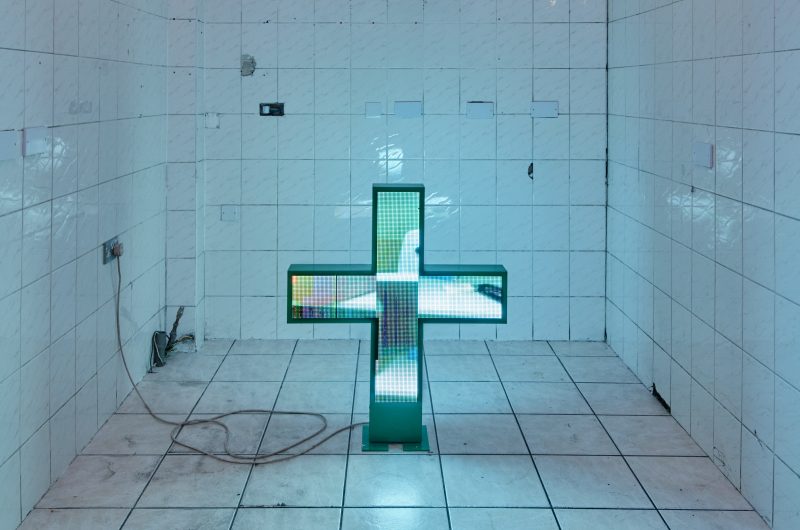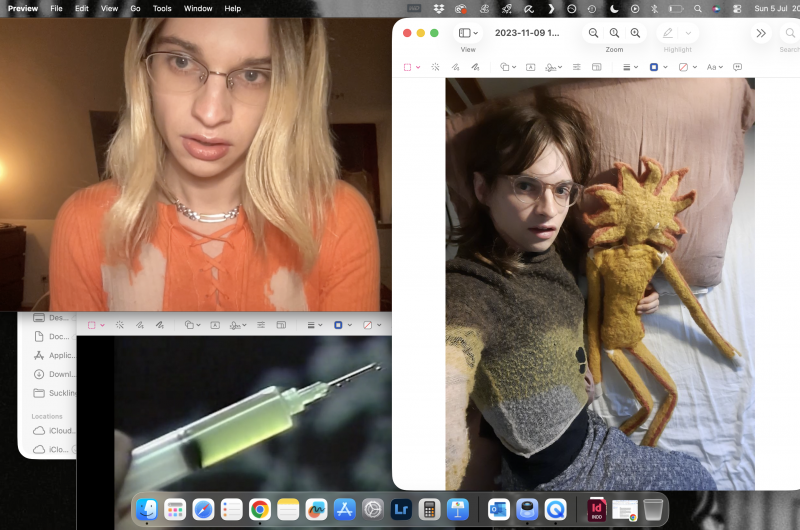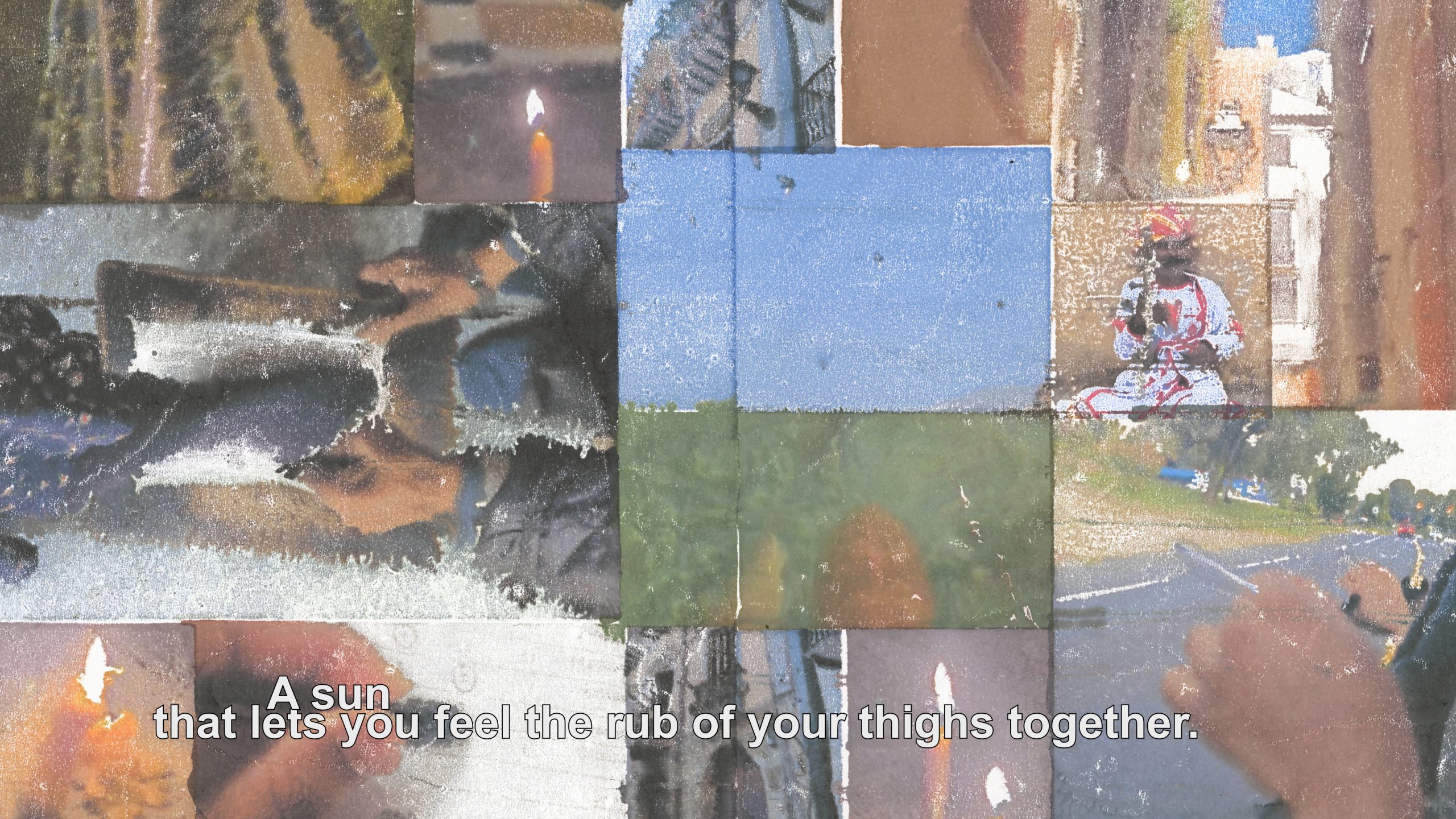
Morisha Moodley, Sideweighs and Backwords, 2026 [still]. Courtesy of the artist.
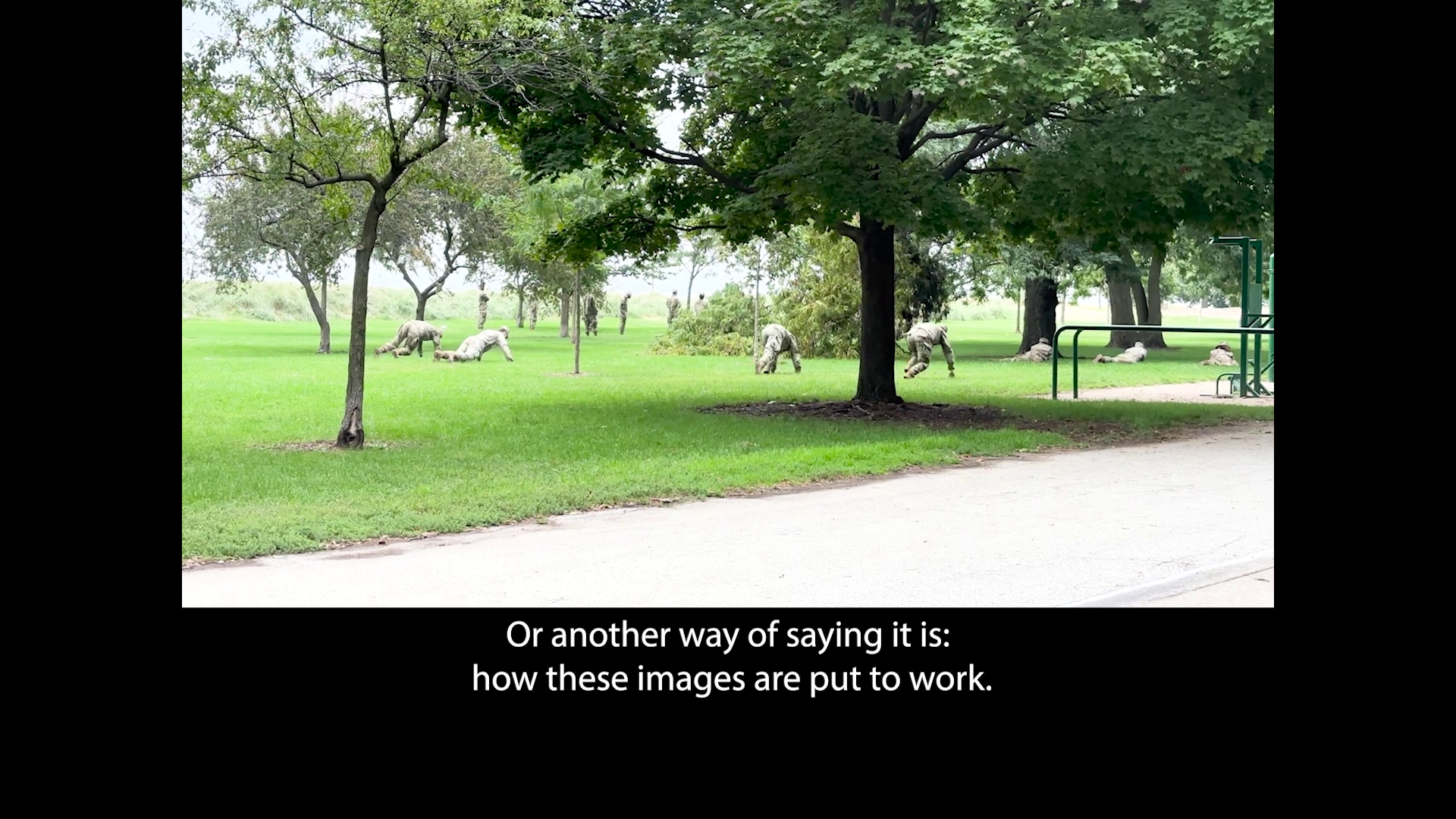
Jordan Lord, All-Around Feel Good, 2024 [still]. Courtesy of LUX.
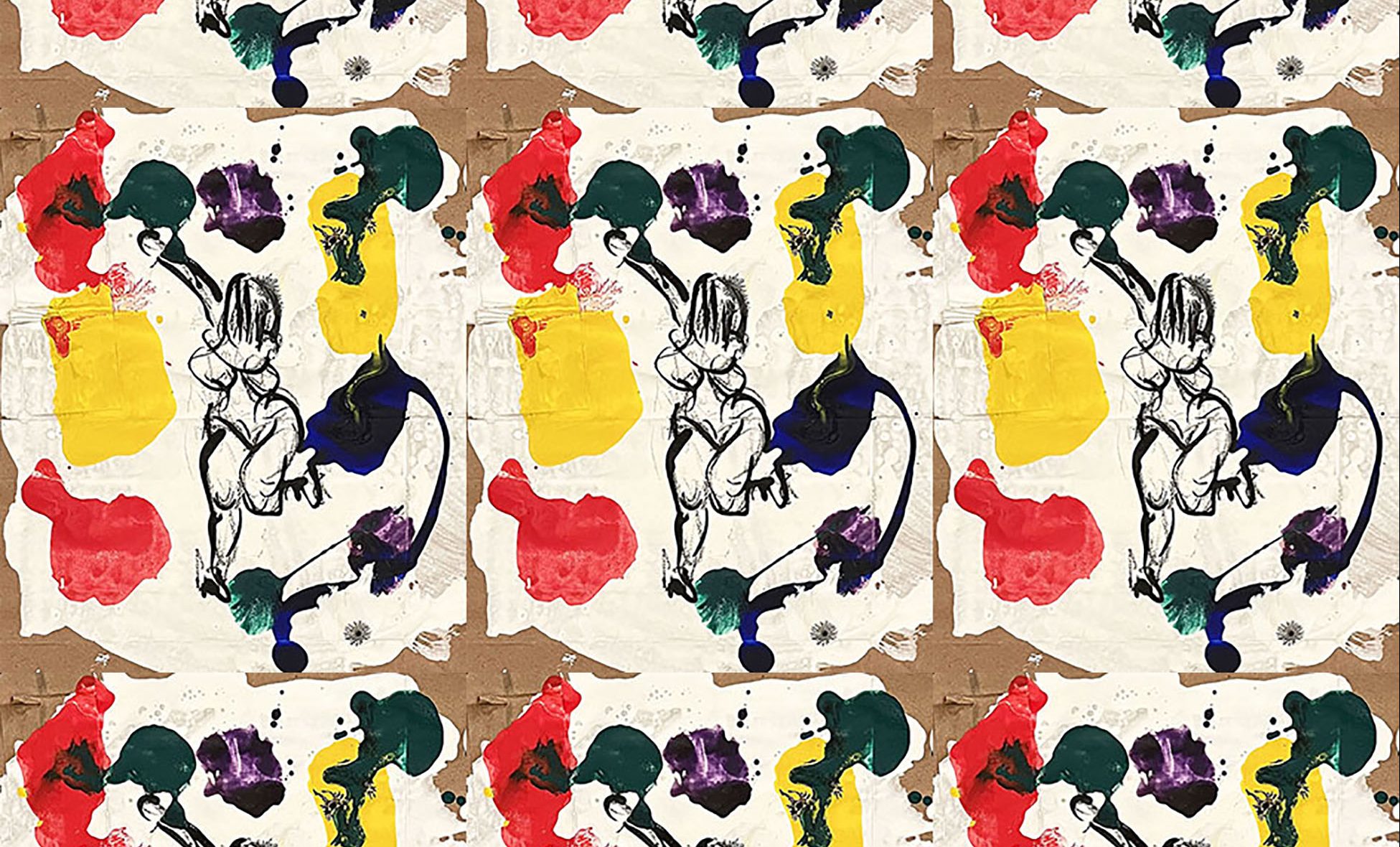
Paula Stuttman, Rotten Representations: one armed go dancer, 2024 [still]. Courtesy of the artist.
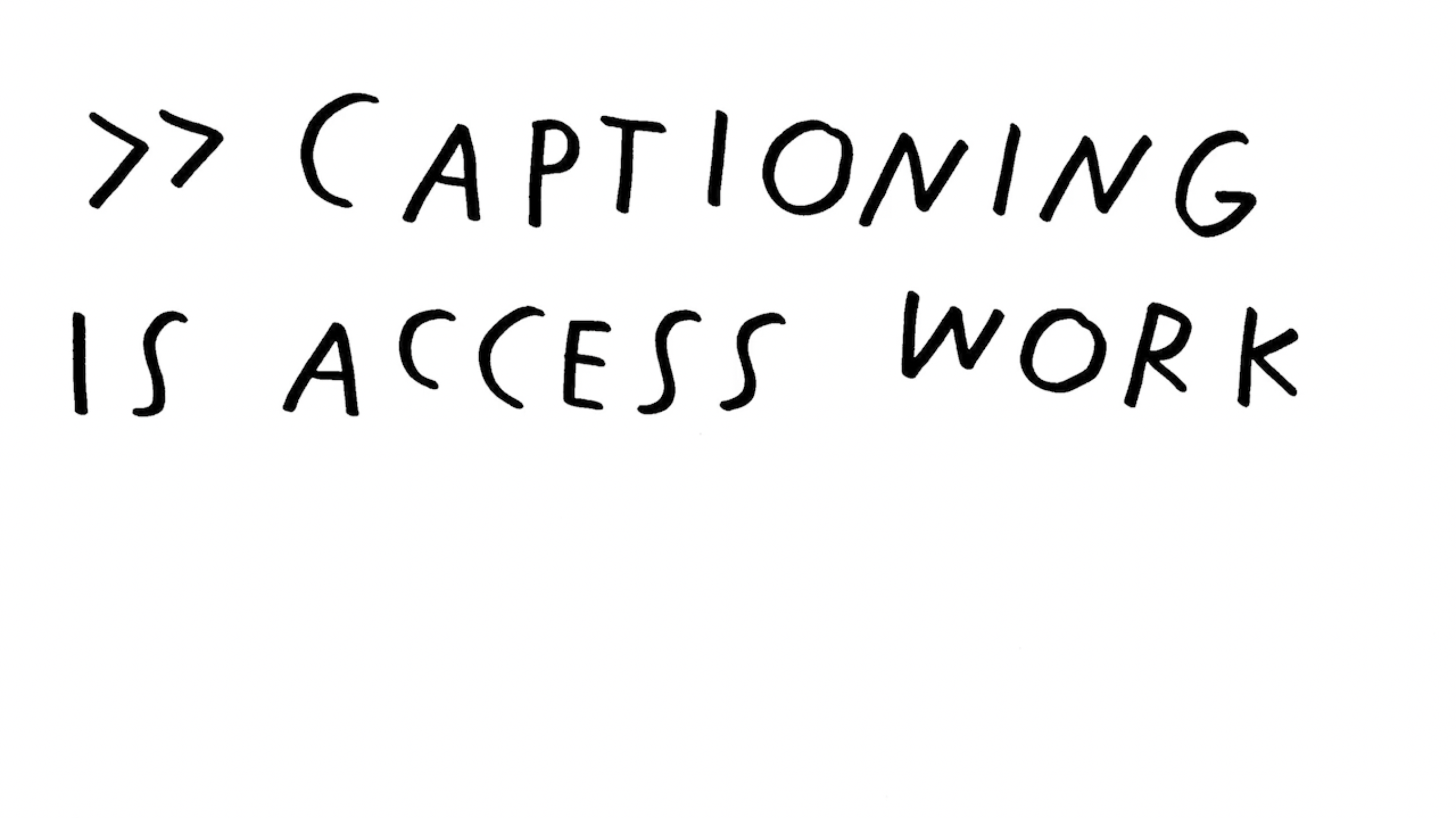
Louise Hickman and Finnegan Shannon, Captioning on Captioning, 2022 [still]. Courtesy of LUX.
![Three identical images side by side show two hands working clay on a pottery wheel. The captions over each image are different. From left to right they read '[shaping]', '[sound of emptiness in the room]', and '[mysterious string music]'.](https://goldsmithscca.art/wp-content/uploads/2026/07/Copy-of-still2.tif)
Seo Hye Lee, [sound of subtitles], 2021 [still]. Courtesy of the artist.
Illegibility for all
Featuring: Seo Hye Lee, Louise Hickman, Jordan Lord, Morisha Moodley, Finnegan Shannon and Paula Stuttman.
Illegibility for all is an online screening event co-curated with Emily Simmons, founder of Crip Cinema Archive, held as part of our current exhibition Flare-Up. The programme takes its name from Carolyn Lazard’s film A Recipe for Disaster. The chosen moving-image works explore the conditions of access in film today. Each work is made by artists for whom access is an active, creative dimension of their practice – not a bolt-on, a translation, or a segregated stage of a film’s lifespan. These filmmakers are inventing new modes of access, integrating it into the fabric of their work, and posing questions to their audiences along the way.
This screening is a space for critique. A place to interrogate the idea of “creative access”. To wonder about the balance of aesthetics and function. To ask questions rather than supply answers – except one: access, everywhere, now.
In An All-Around Feel Good (2024), Jordan Lord asks what it means to be an audience in the wake of the Americans with Disabilities Act. Louise Hickman and Finnegan Shannon’s Captioning on Captioning (2022) attends to the intimate knowledge and care required to produce access. Seo Hye Lee’s [sound of subtitles] (2021) playfully probes the space between language and sound, drawing an analogy between the shaping of clay on a wheel and the way communication shapes meaning.
Morisha Moodley’s Sideweighs and Backwords (2026) foregrounds the imperfect action of memory, revelling in inarticulation to reflect experiences of migration, disability, and mental illness. Paula Stuttman’s Rotten Representations: one armed go go dancer (2024) weaves descriptive subtitles and audio description into a sharp and playful examination of disability representation in the feature film The Last Waltz (1978).
Please sign up for a ticket below, and the screening links will be provided to you. A Q&A between curators Natasha Hoare, Mariana Lemos and Emily Simmons is also available.
Read more…
BIOGRAPHIES
Louise Hickman is an activist and scholar of communication, and uses ethnographic, archival, and theoretical approaches to consider how access is produced for disabled people. Her current project focuses particularly on access produced by real-time stenographers and transcriptive technologies in educational settings. She uses an interdisciplinary lens drawing on feminist theory, critical disability studies, and science and technology studies to consider the historical conditions of access work, and the ways access is co-produced through human (and primarily female) labour, technological systems, and economic models and conditions.
Louise is currently a Research Assoicate at the Minderoo Centre for Technology and Democracy at the University of Cambridge. Louise previously worked as a Senior Research Officer at the London School of Economics and Political Science Department of Media and Communications and at Ada Lovelace Institute’s JUST-AI Network on Data and AI Ethics. She continues to co-convene the JUST AI’s working group on rights, access and refusal. An academic, artist, activist, she earned her PhD in Communication from the University of California, San Diego in 2018, and held a postdoctoral position in the Feminist Labor Lab at UC San Diego. Since 2016, Louise has also worked as an access consultant and speaker for Parkeology, a U.S. based public art program.
Seo Hye Lee is a Somerset based South Korean deaf artist. Drawing on her personal experience of hearing loss and of being a cochlear implant user, Seo Hye explores a world of sound and silence through the mediums of moving image, illustration and multi-sensory installation.
Jordan Lord is a filmmaker, writer, and artist whose work addresses the relationships between historical and emotional debts; framing and support; access, disability, and documentary. Their films have been shown at festivals and venues including MoMA Doc Fortnight, New York Film Festival, Walker Art Center, Union Docs, and Dokufest. Their film Shared Resources (2021) won the John Marshall Award for Contemporary Ethnographic Media at the Camden International Film Festival and the Critics Jury Prize at the Hot Springs Documentary Film Festival. They have presented solo exhibitions at Piper Keys, Artists Space, and Squeaky Wheel. Their work has been featured in publications such as Screen Slate, Filmmaker Magazine, Millennium Film Journal, Film Quarterly, and Hyperallergic.
Morisha Moodley is a London-based moving image artist that works across video, installation, and text, examining the entanglement of race, queerness, disability, and theology through these forms.
Finnegan Shannon is an artist experimenting with forms of access. Some of their recent work includes Alt Text as Poetry, a collaboration with Bojana Coklyat that explores the expressive potential of image description; Do You Want Us Here or Not, a series of benches and cushions designed for exhibition spaces; and Don’t mind if I do, a conveyor-belt-centered exhibition that prioritizes rest and play. Their work has been supported by a Wynn Newhouse Award, an Eyebeam fellowship, a Disability Futures Fellowship, a United States Artists Fellowship, and grants from Art Matters Foundation, Canada Council for the Arts, and the Disability Visibility Project.
Paula Stuttman is an artist based in NYC. She has exhibited at Judson Memorial Church, Good Naked, Shelter Gallery, Broodthaers Society of America, Flux Factory, Catskill Art Society, HOTdog, Queens Museum, TransHudson (NYC) Whitstable Satellite Biennale (UK) 1935 Gallery (Chicago), 11th Hour Gallery, Museum of Fine Arts (Boston) and Centro De Difusion Cultural Del I.P.B.A (Mexico). Screenings include Feeling the Fantasy at the Barbican Centre, Woodstock Film Festival, RestFest Film Festival, New York Short Film Festival and the Millennium Film Workshop. She is the recipient of grants from The New School, the Puffin Foundation and Alumni Traveling Scholarships from the School of the Museum of Fine Arts in Boston. Stuttman is represented by Good Naked Gallery (NYC).
Emily Simmons is a London-based film worker and the founder of Crip Cinema Archive. She has spoken at the BFI and Independent Cinema Office and programmed work for the Barbican, V&A, Filmhouse, MAC, Watershed, and Atlas Cinema. The archive has been featured in Little White Lies.
Crip Cinema Archive is dedicated to documenting disability on screen. It aims to be a resource for those seeking out crip cinema, to launch further discussions about how to define crip cinema – what it is, what it isn’t, and what it could be, and to better crip film futures – in front of and behind the lens – and make them a reality.
Read Less...