TEXT: Donna Marcus Duke in conversation with Olivia Grace Middelboe
As part of the exhibition Inner Heat, by Laila Majid and Louis Blue Newby, writer Donna Marcus Duke was invited by the artists to respond to the ideas of secrecy and exposure which animate their works.
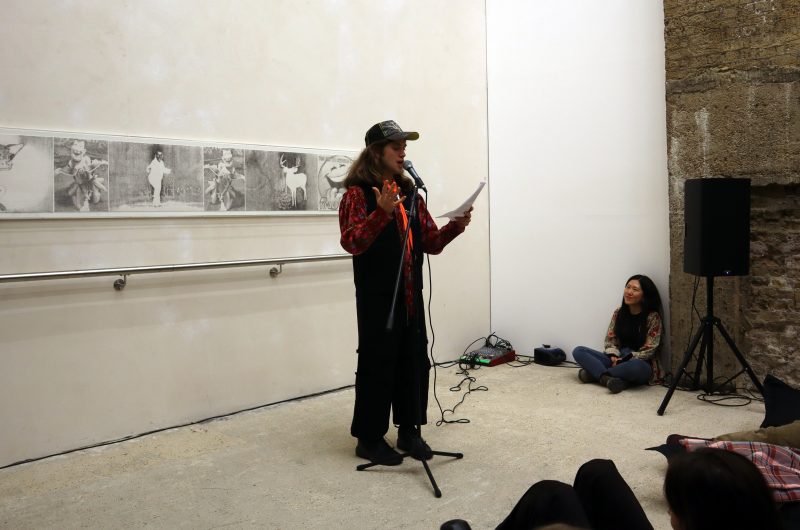
Olivia Grace Middelboe (O.G.M): You performed in Secrecy and Exposure, a poetry night which took place as part of EPISODE 13: LAILA MAJID & LOUIS BLUE NEWBY – Inner Heat. I wondered if you could expand on how those themes are interspersed with your own practice, and in what ways you feel a connection to Majid and Newby’s work?
Donna Marcus Duke (D.M.D): I was invited to read in part because I wrote the catalogue essay for Laila & Louis’ exhibition Beautiful Girls on Top! (2023) at The Shop at Sadie Coles HQ. There’s definitely a big affinity between my interests and theirs. We’re both interested in erotics, sexuality and sexual defiance, especially in how sexually deviant communities can be used as a mode of knowledge production. We both have stacks of wacky porn mags. We both have this interest in sexual internet subcultures, thinking about how they articulate the particularities of demonstrating desire. There’s an interest in how sexual deviancy is mediated and how that mediation can create communities. Thinking about Reddit threads or thinking about porn mags. Laila specifically has been interested in that in relation to film and subversive film mags, for Louis it’s been more faggoty gay porn.
Internet humour and internet culture plays a big part in Louis and Laila’s work and I’ve only realised over the last six months that it also plays a big role in mine. Maybe it’s my age and what I’m around, what I grew up with. I’m either the last millennial or the first Gen-Z depending on how you look at it. Which probably means I’m a millennial, which is quite tragic.
To sum it up, both of us like sexy things, funny things, existential things, and like how those three things can come together to produce something confronting.
O.G.M: For your reading, you performed your text, ‘On Gooning’, which explores public and private desire, sex and violence. Could you explain how the text came about, the choices behind selecting it for Secrecy and Exposure, and what you hoped to convey?
D.M.D: I wanted to read something new. I’d been doing lots of research on gooning and I also had this text on this violent experience that had happened to me. These were two things that I’d been finding really difficult to place anywhere in the projects that I was doing. And then I realised these are really relevant together, they have a relationship, they’re relevant to Louis and Laila, and I knew Louis and Laila would love gooning. That’s why I chose it.
Because I was piecing it together for the reading, I could angle it towards how I understood the exhibition and its themes. We love humour, we love internet culture, we love erotics, we love sexuality, so gooning is a good lynchpin because it’s funny, it’s unexpected, it’s sexy, but it’s also kind of gross. In terms of concept, at least in my life, it feels like there’s so much stake in desire, both in terms of feeling desirable and feeling desire and the consequences those two things have on how your identity is perceived. Who you desire and how you are desired are basically what gender and sexuality are in a way. How you’re desired is your gender, who you desire is your sexuality. We live in a world where we’re taught those two things are really important, whether they are or not, especially amongst internet scenes.
I’m a transfemme notionally, that’s how I’m understood, but I’m also a faggot. That is the tension at the moment that has been the most confronting for me. This is part, in some ways, what the text is about. I understand myself as woman, woman adjacent or femme, but I desire men who like men. There’s this notion that how you desire defines who you are, but there’s also this notion that it’s your gender that defines you, but when those two things are in conflict, where does that land you? Other people think of desire as something that really galvanises your selfhood, where for me it breaks it. I think there is no more potent realm where this threat is exhibited than when you’re wanking, because it’s just you and the algorithm. It is you and this machine that learns what you like, there’s no lying, an algorithm knows you in ways that other people don’t. I guess part of my interest in gooning is that tension, because gooning I understand as the mystical harnessing of wanking. I think a lot of people can find that desire confronting. I talk in the text about conservatives who toss off to trans women, who have their wives at home. That threat of desire is rejected and then manifests in violence. That manifestation can then become pleasure in its own way because of how pain and pleasure are intertwined.
This relationship between violence and desire really resonated with how I was understanding this experience I had a couple of months ago, where two men were taking ecstatic, carnal delight in trying to run me over with a motorbike, explicitly because I was a ‘tranny’, in their words. I realised that the tension of what desire you want to keep private and what desire you allow to be public was a way to help me understand what was going on in their heads. It was a technology or a mechanism to understand that situation in a way that I could continue through. It allows me to live with it more.
There can be a lot of stakes around the things we want to keep secret, especially desires. I’m an open book, but there’s one thing that I keep for me, and that’s my kink. It’s not particularly remarkable, it’s not particularly scandalous, but because of the relationship of desire with that fetish, and because it’s something that I choose to keep secret, there’s so much charge. If I encounter said fetish in a space that is not a sexual sphere, that does not belong. There’s a fear that there will be desire there, that sexuality will arise in a place where you don’t want sexuality. Tapping into those logics or affects has been a useful way of understanding specifically how trans violence that is related to desire manifests.
O.G.M: You are a frequent collaborator with Sticky Fingers Publishing, a South East London intra-dependent press run by Kaiya Waerea and Sophie Paul. They recently included your essay, ‘I Doubt Therefore I Am’, in the first edition of their new periodical ‘Get Rid of Meaning: A Journal of Interdisciplinary Writing’, and you have worked with the press to organise events in queer bars within and beyond London. Could you elaborate on how this relationship started, and how it has developed over time?
D.M.D: We were all on the MA Writing at the RCA and Kaiya and Sophie had started Sticky Fingers at Goldsmiths a couple of years prior. I was asked to guest edit one of their FDBN series on the nocturnal, nightlife and nighttime activity. Because I’ve run a club night for almost ten years, and because it was about the nocturnal, we had the idea of doing a reading event which I would host in drag. We did that at The Glory in 2022, and then it went so well that we decided to keep on going.
My role within Sticky Fingers, apart from begging them to publish my work, is to host and help organise the events. They do everything else because they’re geniuses and I put on a wig and chat about. Reading events, which I think of as a mode of nightlife, traditionally have this stoicism where you sit earnestly and you listen quietly and it’s all very serious and self regarding. For us, it was important to value the texts that were being written and hold space for seriousness and listening, but we wanted readings to be fun and energising and inspiring and funny and silly and loose and relaxed. You can come in and listen but you don’t need to portray yourself as this earnest literary listener. In terms of blending the traditional reading event with queer nightlife proper, I think that’s been an important part of those events, and I love hosting.
I’ve run a club night called Haute Mess since 2016, which started in Oxford and then we toured, and we’ve now settled in London again at Dalston Superstore. Through the practice of running a queer nightlife space, you learn a lot about community building, you learn a lot about space making, and you learn a lot about the practice of queer politics. There can be a lot of spiel about queer politics and theory making but when you are making a space, when you are performing, you’re putting your body in those spaces, you’re having other people’s bodies in those spaces, you have to keep them safe and really have to think about the practice of queer space making.
O.G.M: You included Sticky Fingers in a piece for AnOther Mag, ‘The Indie Presses Leading London’s Thriving Underground Literary Scene’. I wanted to ask if you could talk about the changes you’ve seen, if you feel there is anything missing or lacking, and what your hopes are for the future of the London publishing scene?
D.M.D: I wish, although it’s not for me to wish this, that BIPOC writing communities were more integrated into the scene I see in London. While there is class engagement, it’s generally pretty middle class. Maybe it’s to ask the scene to think a bit more about why it’s so white, why it’s so middle-class, that’s something I’d be interested in us thinking about a little bit more.
I always think there should be more readings. There are loads at the moment, which is great – The BitterSweet Review, Sticky Fingers, SISSY ANARCHY, TISSUE – to name a few, but I always think there should be more. I don’t think you can have a writing scene without a reading scene. That’s where we get together, and that’s vital.
I’d like to see more integration between the poetry scene and the writing scene. They are quite distinct in some ways but I maybe don’t see as much crossover as I would like. That’s what I really enjoyed about Secrecy and Exposure. We had a bunch of poets and we had me (I don’t really think of myself as a poet). More skill sharing is always nice.
Maybe this is really going against what indie publishing is, but maybe a bit more dialogue and interest from agents and the publishing industry and the literary world. The independent publishing scene is taken really seriously by the art world, it feels very supported, but it feels quite detached in some ways from the literary world. It would be nice to see the indie publishing scene as a really fruitful way to bring together the publishing world and the art world a little bit more.
O.G.M: How do the process and themes of your practice differ between your writing and your performance?
I think in many ways subconsciously my writing is always to be read aloud. Performance trickles into my writing in that way. I don’t think it works the other way really. Apart from when I’m reading texts aloud, the way that I perform generally now is almost all improv. It very much responds to the moment and it’s much more about getting myself into a state of mind that allows me then to respond to a room. I guess that comes from drag, which I’ve been doing for about ten years. Whether you’re hosting with a mic and responding to an audience, whether you’re gogo-ing (which is all about vibe matching), a lot of it is very much about a presentness in performance.
Writing is almost the total opposite. I will have a text that I’ll go over again and again, and re-edit, and churn over and think about for months or years. If performance is about getting to a state of absolutely no thinking and just doing, writing in many ways is the practice of thinking, of clarifying and articulating thought and feeling and research in the most appropriate way. Whereas performance is much more about an immediacy.
O.G.M: You’re an editor and organiser of TISSUE, which combines events and anthologies of writing by trans* practitioners. Could you expand on the impetus behind this project?
D.M.D: TISSUE started in 2022 in collaboration with another writer called Sam Moore. There was this burgeoning trans writing scene at the time that was coming out of the pandemic – Sticky Fingers was publishing a lot of stuff, BitterSweet had just started, Pilot Press too, which is amongst the best independent publishers out there. We were seeing all of these names and anthologies, and we knew all these people tangentially but we didn’t have a place to come together. So we decided to do these reading events. We contacted FRIEZE No. 9 Cork Street and we were just in their basement for about a year. It was a way to collectivise. We put out our first anthology, which was on the theme of making in transness, and we kept on going with the events.
Our residency at FRIEZE had ended, we both had a bit of ennui about a type of liberal, representation-led trans politics, which is exactly the type of politics we all use to get into institutions, to get funding. We say we stand for community, and we’re using this identity to get places, but how can we wield these uncomfortable uses of transness to actually contribute something materially to our writers and our community? We realised that we could use the model of a fundraiser for the readings. Since last April, all of the readings we’ve done raised money for a specific individual to access healthcare. It’s all well and good that we’re talking and thinking about transness, but how can we use this collectivising to actually help each other beyond discourse?
We’re now starting this residency at the CCA where we’ll be continuing these fundraising reading events. The first one is actually going to be with Kaiya Waerea. It feels really nice to be able to support them because they’ve given a lot to the community. In between, we’re going to try and do some workshops to help the writers in our community have an opportunity to do some pedagogy and share some of their knowledge and practices. There’s an upskilling element to it, but also a material benefit. If we’re understanding TISSUE as a creative literary organisation, having a material politic that’s demonstrable has been really important.
O.G.M: Where do you feel most at home, as a writer or as a performer? Is there a mode of working that feels the most natural to you?
D.M.D: The story in Balamory is when I was younger I wanted to be an actor. I always found the idea of writing really scary. I thought writing was one of the most terrifying things you could do. I used to get stage fright but I loved it. I love performing, I love being on stage. Then the pandemic hit and I started to realise that even though times are changing, actually to be trans and to be an actor is quite complicated, and I was maintaining quite a boyish look in order to get cast in things and I wasn’t sure that’s how I wanted to live my life. Then I thought I was going to be an academic and I ended up doing the MA Writing because I wanted to do something quite interdisciplinary, and I realised I love writing. I started in the essay form and it spiralled from there.
I was doing drag and nightlife performance alongside and didn’t really think much of it and it’s only been over the last year where I’ve really started to realise that I’m still a performer. I know that sounds bonkers to say, I perform all the time, but that’s still an important part of my practice rather than just a fun hobby that I do. I always understand myself as a writer, but actually I probably perform more than I write. It’s a funny tension.
O.G.M: What are you reading at the moment? And are there any particular writers or texts that you like to recommend?
D.M.D: A book that I loved is Ripcord by Nate Lippens. It’s a really nice, funny, erudite, aphoristic follow up to My Dead Book. Disquiet Drive by Hesse K., she’s incredible and I think she’s going to be a new superstar.
I just read Anne Carson’s Autobiography of Red for the first time. She’s got an amazing way of writing, it’s long line poetry and it’s epic. Hesse K. said that reading poetry makes you a better writer and I think that’s true. I never used to read much poetry and I’m trying to start. There’s an attentiveness to language and sentence structure and image that’s amazing as it washes over you.
Last autumn I read Batailles’ Eroticism for the first time. There’s so much discussion of eroticism and erotics at the moment in different forms. I found Batailles’ writing really compelling, as a primer on transgression I keep wanting to come back to it and engage with it again.
I always love Margery Kempe by Robert Glück. Audre Lorde I always come back to a lot. I’ve been reading more bell hooks.
A Short History of Trans Misogyny I think is groundbreaking. I will say this boldly and assuredly – anyone writing about or through transness today has to read this. It really clarified a lot of the trips and pitfalls of Western trans movements. It identified a lot of hesitations or worries I’d had about certain movements, or things I was doing or believing. Jules Gill-Peterson is one of the best in the game in terms of trans theory.
Pearls from Their Mouth by Pear Nuallak. Pear is amazing, they’re one of the least compromising people in a way that’s really inspiring. They play nicely with fiction and essay in a way that I find exciting. It was published by Hajar Press, who are fab. They’re a slightly bigger publisher that does these amazing monographs.
O.G.M: Finally, can you share details of anything new you’re working on that we should look out for?
D.M.D: I’m trying to finish my book, which has been in the machine for a couple of years. I am doing TISSUE stuff. I’m working with a kink curator called Matt Scully who’s amazing. We’re going to do some writing workshops in relation to kink nightlife. I’ve done a lot of work on rave and partying, so I’m working with him to look at another aspect of nightlife. I’m working on an essay for the photographer Michele Baron, who’s a nightlife photographer that photographs my club night.
BIOGRAPHY:
Donna Marcus Duke is a writer, performer and nightlife organiser based in London, currently finishing their MA in Writing at the Royal College of Art.
Instagram: @donna.the.first
As part of the exhibition Inner Heat, by Laila Majid and Louis Blue Newby, writer Donna Marcus Duke was invited by the artists to respond to the ideas of secrecy and exposure which animate their works.
Olivia Grace Middelboe (O.G.M): You performed in Secrecy and Exposure, a poetry night which took place as part of EPISODE 13: LAILA MAJID & LOUIS BLUE NEWBY – Inner Heat. I wondered if you could expand on how those themes are interspersed with your own practice, and in what ways you feel a connection to Majid and Newby’s work?
Donna Marcus Duke (D.M.D): I was invited to read in part because I wrote the catalogue essay for Laila & Louis’ exhibition Beautiful Girls on Top! (2023) at The Shop at Sadie Coles HQ. There’s definitely a big affinity between my interests and theirs. We’re both interested in erotics, sexuality and sexual defiance, especially in how sexually deviant communities can be used as a mode of knowledge production. We both have stacks of wacky porn mags. We both have this interest in sexual internet subcultures, thinking about how they articulate the particularities of demonstrating desire. There’s an interest in how sexual deviancy is mediated and how that mediation can create communities. Thinking about Reddit threads or thinking about porn mags. Laila specifically has been interested in that in relation to film and subversive film mags, for Louis it’s been more faggoty gay porn.
Internet humour and internet culture plays a big part in Louis and Laila’s work and I’ve only realised over the last six months that it also plays a big role in mine. Maybe it’s my age and what I’m around, what I grew up with. I’m either the last millennial or the first Gen-Z depending on how you look at it. Which probably means I’m a millennial, which is quite tragic.
To sum it up, both of us like sexy things, funny things, existential things, and like how those three things can come together to produce something confronting.
O.G.M: For your reading, you performed your text, ‘On Gooning’, which explores public and private desire, sex and violence. Could you explain how the text came about, the choices behind selecting it for Secrecy and Exposure, and what you hoped to convey?
D.M.D: I wanted to read something new. I’d been doing lots of research on gooning and I also had this text on this violent experience that had happened to me. These were two things that I’d been finding really difficult to place anywhere in the projects that I was doing. And then I realised these are really relevant together, they have a relationship, they’re relevant to Louis and Laila, and I knew Louis and Laila would love gooning. That’s why I chose it.
Because I was piecing it together for the reading, I could angle it towards how I understood the exhibition and its themes. We love humour, we love internet culture, we love erotics, we love sexuality, so gooning is a good lynchpin because it’s funny, it’s unexpected, it’s sexy, but it’s also kind of gross. In terms of concept, at least in my life, it feels like there’s so much stake in desire, both in terms of feeling desirable and feeling desire and the consequences those two things have on how your identity is perceived. Who you desire and how you are desired are basically what gender and sexuality are in a way. How you’re desired is your gender, who you desire is your sexuality. We live in a world where we’re taught those two things are really important, whether they are or not, especially amongst internet scenes.
I’m a transfemme notionally, that’s how I’m understood, but I’m also a faggot. That is the tension at the moment that has been the most confronting for me. This is part, in some ways, what the text is about. I understand myself as woman, woman adjacent or femme, but I desire men who like men. There’s this notion that how you desire defines who you are, but there’s also this notion that it’s your gender that defines you, but when those two things are in conflict, where does that land you? Other people think of desire as something that really galvanises your selfhood, where for me it breaks it. I think there is no more potent realm where this threat is exhibited than when you’re wanking, because it’s just you and the algorithm. It is you and this machine that learns what you like, there’s no lying, an algorithm knows you in ways that other people don’t. I guess part of my interest in gooning is that tension, because gooning I understand as the mystical harnessing of wanking. I think a lot of people can find that desire confronting. I talk in the text about conservatives who toss off to trans women, who have their wives at home. That threat of desire is rejected and then manifests in violence. That manifestation can then become pleasure in its own way because of how pain and pleasure are intertwined.
This relationship between violence and desire really resonated with how I was understanding this experience I had a couple of months ago, where two men were taking ecstatic, carnal delight in trying to run me over with a motorbike, explicitly because I was a ‘tranny’, in their words. I realised that the tension of what desire you want to keep private and what desire you allow to be public was a way to help me understand what was going on in their heads. It was a technology or a mechanism to understand that situation in a way that I could continue through. It allows me to live with it more.
There can be a lot of stakes around the things we want to keep secret, especially desires. I’m an open book, but there’s one thing that I keep for me, and that’s my kink. It’s not particularly remarkable, it’s not particularly scandalous, but because of the relationship of desire with that fetish, and because it’s something that I choose to keep secret, there’s so much charge. If I encounter said fetish in a space that is not a sexual sphere, that does not belong. There’s a fear that there will be desire there, that sexuality will arise in a place where you don’t want sexuality. Tapping into those logics or affects has been a useful way of understanding specifically how trans violence that is related to desire manifests.
O.G.M: You are a frequent collaborator with Sticky Fingers Publishing, a South East London intra-dependent press run by Kaiya Waerea and Sophie Paul. They recently included your essay, ‘I Doubt Therefore I Am’, in the first edition of their new periodical ‘Get Rid of Meaning: A Journal of Interdisciplinary Writing’, and you have worked with the press to organise events in queer bars within and beyond London. Could you elaborate on how this relationship started, and how it has developed over time?
D.M.D: We were all on the MA Writing at the RCA and Kaiya and Sophie had started Sticky Fingers at Goldsmiths a couple of years prior. I was asked to guest edit one of their FDBN series on the nocturnal, nightlife and nighttime activity. Because I’ve run a club night for almost ten years, and because it was about the nocturnal, we had the idea of doing a reading event which I would host in drag. We did that at The Glory in 2022, and then it went so well that we decided to keep on going.
My role within Sticky Fingers, apart from begging them to publish my work, is to host and help organise the events. They do everything else because they’re geniuses and I put on a wig and chat about. Reading events, which I think of as a mode of nightlife, traditionally have this stoicism where you sit earnestly and you listen quietly and it’s all very serious and self regarding. For us, it was important to value the texts that were being written and hold space for seriousness and listening, but we wanted readings to be fun and energising and inspiring and funny and silly and loose and relaxed. You can come in and listen but you don’t need to portray yourself as this earnest literary listener. In terms of blending the traditional reading event with queer nightlife proper, I think that’s been an important part of those events, and I love hosting.
I’ve run a club night called Haute Mess since 2016, which started in Oxford and then we toured, and we’ve now settled in London again at Dalston Superstore. Through the practice of running a queer nightlife space, you learn a lot about community building, you learn a lot about space making, and you learn a lot about the practice of queer politics. There can be a lot of spiel about queer politics and theory making but when you are making a space, when you are performing, you’re putting your body in those spaces, you’re having other people’s bodies in those spaces, you have to keep them safe and really have to think about the practice of queer space making.
O.G.M: You included Sticky Fingers in a piece for AnOther Mag, ‘The Indie Presses Leading London’s Thriving Underground Literary Scene’. I wanted to ask if you could talk about the changes you’ve seen, if you feel there is anything missing or lacking, and what your hopes are for the future of the London publishing scene?
D.M.D: I wish, although it’s not for me to wish this, that BIPOC writing communities were more integrated into the scene I see in London. While there is class engagement, it’s generally pretty middle class. Maybe it’s to ask the scene to think a bit more about why it’s so white, why it’s so middle-class, that’s something I’d be interested in us thinking about a little bit more.
I always think there should be more readings. There are loads at the moment, which is great – The BitterSweet Review, Sticky Fingers, SISSY ANARCHY, TISSUE – to name a few, but I always think there should be more. I don’t think you can have a writing scene without a reading scene. That’s where we get together, and that’s vital.
I’d like to see more integration between the poetry scene and the writing scene. They are quite distinct in some ways but I maybe don’t see as much crossover as I would like. That’s what I really enjoyed about Secrecy and Exposure. We had a bunch of poets and we had me (I don’t really think of myself as a poet). More skill sharing is always nice.
Maybe this is really going against what indie publishing is, but maybe a bit more dialogue and interest from agents and the publishing industry and the literary world. The independent publishing scene is taken really seriously by the art world, it feels very supported, but it feels quite detached in some ways from the literary world. It would be nice to see the indie publishing scene as a really fruitful way to bring together the publishing world and the art world a little bit more.
O.G.M: How do the process and themes of your practice differ between your writing and your performance?
I think in many ways subconsciously my writing is always to be read aloud. Performance trickles into my writing in that way. I don’t think it works the other way really. Apart from when I’m reading texts aloud, the way that I perform generally now is almost all improv. It very much responds to the moment and it’s much more about getting myself into a state of mind that allows me then to respond to a room. I guess that comes from drag, which I’ve been doing for about ten years. Whether you’re hosting with a mic and responding to an audience, whether you’re gogo-ing (which is all about vibe matching), a lot of it is very much about a presentness in performance.
Writing is almost the total opposite. I will have a text that I’ll go over again and again, and re-edit, and churn over and think about for months or years. If performance is about getting to a state of absolutely no thinking and just doing, writing in many ways is the practice of thinking, of clarifying and articulating thought and feeling and research in the most appropriate way. Whereas performance is much more about an immediacy.
O.G.M: You’re an editor and organiser of TISSUE, which combines events and anthologies of writing by trans* practitioners. Could you expand on the impetus behind this project?
D.M.D: TISSUE started in 2022 in collaboration with another writer called Sam Moore. There was this burgeoning trans writing scene at the time that was coming out of the pandemic – Sticky Fingers was publishing a lot of stuff, BitterSweet had just started, Pilot Press too, which is amongst the best independent publishers out there. We were seeing all of these names and anthologies, and we knew all these people tangentially but we didn’t have a place to come together. So we decided to do these reading events. We contacted FRIEZE No. 9 Cork Street and we were just in their basement for about a year. It was a way to collectivise. We put out our first anthology, which was on the theme of making in transness, and we kept on going with the events.
Our residency at FRIEZE had ended, we both had a bit of ennui about a type of liberal, representation-led trans politics, which is exactly the type of politics we all use to get into institutions, to get funding. We say we stand for community, and we’re using this identity to get places, but how can we wield these uncomfortable uses of transness to actually contribute something materially to our writers and our community? We realised that we could use the model of a fundraiser for the readings. Since last April, all of the readings we’ve done raised money for a specific individual to access healthcare. It’s all well and good that we’re talking and thinking about transness, but how can we use this collectivising to actually help each other beyond discourse?
We’re now starting this residency at the CCA where we’ll be continuing these fundraising reading events. The first one is actually going to be with Kaiya Waerea. It feels really nice to be able to support them because they’ve given a lot to the community. In between, we’re going to try and do some workshops to help the writers in our community have an opportunity to do some pedagogy and share some of their knowledge and practices. There’s an upskilling element to it, but also a material benefit. If we’re understanding TISSUE as a creative literary organisation, having a material politic that’s demonstrable has been really important.
O.G.M: Where do you feel most at home, as a writer or as a performer? Is there a mode of working that feels the most natural to you?
D.M.D: The story in Balamory is when I was younger I wanted to be an actor. I always found the idea of writing really scary. I thought writing was one of the most terrifying things you could do. I used to get stage fright but I loved it. I love performing, I love being on stage. Then the pandemic hit and I started to realise that even though times are changing, actually to be trans and to be an actor is quite complicated, and I was maintaining quite a boyish look in order to get cast in things and I wasn’t sure that’s how I wanted to live my life. Then I thought I was going to be an academic and I ended up doing the MA Writing because I wanted to do something quite interdisciplinary, and I realised I love writing. I started in the essay form and it spiralled from there.
I was doing drag and nightlife performance alongside and didn’t really think much of it and it’s only been over the last year where I’ve really started to realise that I’m still a performer. I know that sounds bonkers to say, I perform all the time, but that’s still an important part of my practice rather than just a fun hobby that I do. I always understand myself as a writer, but actually I probably perform more than I write. It’s a funny tension.
O.G.M: What are you reading at the moment? And are there any particular writers or texts that you like to recommend?
D.M.D: A book that I loved is Ripcord by Nate Lippens. It’s a really nice, funny, erudite, aphoristic follow up to My Dead Book. Disquiet Drive by Hesse K., she’s incredible and I think she’s going to be a new superstar.
I just read Anne Carson’s Autobiography of Red for the first time. She’s got an amazing way of writing, it’s long line poetry and it’s epic. Hesse K. said that reading poetry makes you a better writer and I think that’s true. I never used to read much poetry and I’m trying to start. There’s an attentiveness to language and sentence structure and image that’s amazing as it washes over you.
Last autumn I read Batailles’ Eroticism for the first time. There’s so much discussion of eroticism and erotics at the moment in different forms. I found Batailles’ writing really compelling, as a primer on transgression I keep wanting to come back to it and engage with it again.
I always love Margery Kempe by Robert Glück. Audre Lorde I always come back to a lot. I’ve been reading more bell hooks.
A Short History of Trans Misogyny I think is groundbreaking. I will say this boldly and assuredly – anyone writing about or through transness today has to read this. It really clarified a lot of the trips and pitfalls of Western trans movements. It identified a lot of hesitations or worries I’d had about certain movements, or things I was doing or believing. Jules Gill-Peterson is one of the best in the game in terms of trans theory.
Pearls from Their Mouth by Pear Nuallak. Pear is amazing, they’re one of the least compromising people in a way that’s really inspiring. They play nicely with fiction and essay in a way that I find exciting. It was published by Hajar Press, who are fab. They’re a slightly bigger publisher that does these amazing monographs.
O.G.M: Finally, can you share details of anything new you’re working on that we should look out for?
D.M.D: I’m trying to finish my book, which has been in the machine for a couple of years. I am doing TISSUE stuff. I’m working with a kink curator called Matt Scully who’s amazing. We’re going to do some writing workshops in relation to kink nightlife. I’ve done a lot of work on rave and partying, so I’m working with him to look at another aspect of nightlife. I’m working on an essay for the photographer Michele Baron, who’s a nightlife photographer that photographs my club night.
BIOGRAPHY:
Donna Marcus Duke is a writer, performer and nightlife organiser based in London, currently finishing their MA in Writing at the Royal College of Art.
Instagram: @donna.the.first
Read Less...