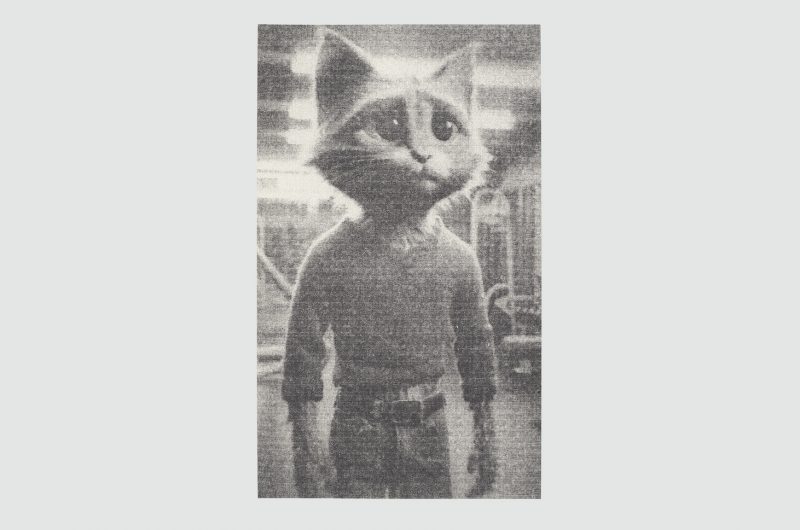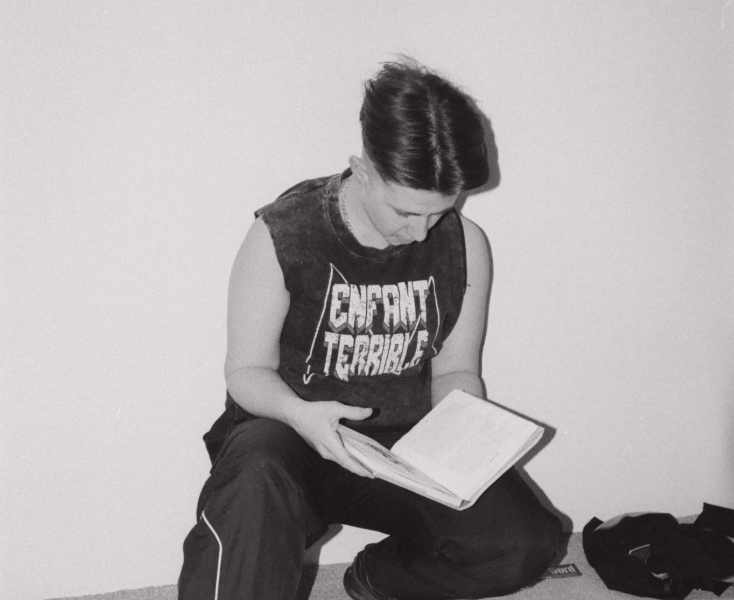
Lydia Garnett, 'Between the Stacks' Goldsmiths CCA , Jan 2024
TEXT: D Mortimer in conversation with Olivia Grace Middelboe
As part of the exhibition Inner Heat, by Laila Majid and Louis Blue Newby, writer D Mortimer was invited by the artists to respond to the ideas of secrecy and exposure which animate their works.
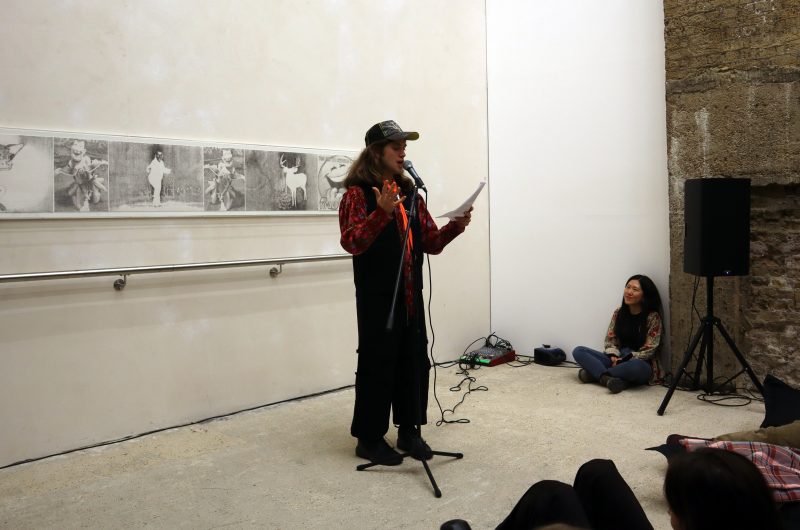
Olivia Grace Middelboe (O.G.M): You performed in Secrecy and Exposure, a poetry night which took place as part of EPISODE 13: LAILA MAJID & LOUIS BLUE NEWBY – Inner Heat. I wondered if you could expand on how those themes are interspersed with your own practice, and in what ways you feel a connection to Majid and Newby’s work?
D Mortimer (D.M): I think the language of digital intimacies attracted me to Majid and Newby’s work. And how all human communication is encrypted in one way or another. In a way we are all shouting into the wind in an effort to understand or be understood. That’s what interests me, and I think that’s what comes out of my work a lot. The limits of articulation and the problem of comprehension. I’m meeting you today, for instance, and you’re bringing all your history, experiences, cultural references, biases, familial references, life experience. And so I can give you an answer to your question, but everything I say is inflected with the weight of my personal history too. So when we try to communicate, we’re also consciously and unconsciously seeing each other through those private lenses too. Hearing what we want to hear in a way. It’s the language of hearing I suppose. I see it like white noise on an old television. Human communication is as imprecise as that. It is this constant effort to decode one another all the time, which produces frustration and misinterpretation of course, even violence. But in those clashes of comprehension, possibility arises too. And discovery.
I think that’s why I chose to read what I did for the event (a poem called so not to die) because it kind of dealt with that idea, of the pursuit of trying and failing to understand another human being and the feelings you have for one another. I saw those themes in the exhibition too, the idea of surface and depth, digital bodies and digital planes. It felt to me like the exhibition was an assemblage of all these kind of familiar but strange, comforting but disconcerting objects and images. And these snatches and images and cultural ephemera exact power over my writing too. I use glimpses and snapshots of artefact and memoir, of song lyrics, and conversation in my work. So it felt like a natural fit.
O.G.M: You’ve touched on this a little already, but could you explain the choices behind the reading you selected for Secrecy and Exposure?
D.M: I was working on a poem at the time I got the invitation called so not to die, it’s a bit of an emo poem, it’s definitely got an emo title! And I was thinking, the themes I’m working with within this poem – intimacy, miscommunication, endangered love, but faith too, and a belief in love – all that seemed to lend itself to the work.
When I was in the gallery space, with its beautiful high ceilings and atrium, I knew I wanted to add a performative aspect to my reading. And I thought about how I might use the sculptural elements of Louis and Laila’s work to potentially add to the performance. I had this initial idea that after I’d read out the poem, I’d arrange for a friend of mine to call me up and I’d be like, “no, no, no, I can’t talk right now, I’m in a performance” and that would sort of be a comment on how it’s really difficult to maintain relationships remotely (she lives in Sweden and we can never find a time to talk). And I wanted to think about what that means for our relationship, you know, when it has to be so conducted in this precarious temporality. Our relationship is now wholly made up of WhatsApp messages, Instagram DMs and FaceTime calls and our experiences of each other are now fully dependent on signal, Wi-Fi, battery etc. Like, how does that change the nature of connecting.
So I wanted to show that through this kind of hurried and stifled conversation about what it means to fall for someone. And the process it entails. Which is all about signs! Like signs you like each other. Signs you feel something. Signs you are on the same page. It’s also a really precarious time, that initial falling, and also so reliant on what messages are said and how they are received.
In my poem I have this symbol of falling asleep on a Lime bike, and nearly getting hit by a truck. And that becomes, I guess, a kind of metaphor for those early (blissful! torturous!) stages of love. It makes you feel insane.
What I ended up doing is collating some voicenotes that my friend and I had shared to each other about the performance when it was in progress. And I ended up playing these after carting my laptop around the space and playing a song by The Cure called ‘Catch’ which I was listening to a lot at the time when I was writing the piece. It seemed to me that Robert Smith’s lyrics encapsulated what I was trying to say about a relationship that has taken on this immaterial, almost ghostly, aspect. It starts ‘Yeah I know who you remind me of / A girl I think I used to know’. It all became about this too, because the voicenote was me trying to remember the song and not remembering it, so humming it to my friend and getting the lyrics wrong. It was all about thinking something or someone is in your grasp and then realising they’re not actually and never were maybe. And the freedom in that, as well as the pain and grief maybe. The guy singing in the song doesn’t even remember the name of the girl that made this impression on him. This idea of falling for someone you don’t know yet, and all the faith and trust that requires. In a way those early stages of love always involve a metaphysical struggle, like you are falling for a phantom, and you must place your trust in a slippery feeling. Which is kind of anti-Darwinian actually, or seems that way to me now. Love requires a lot of getting into scrapes that aren’t that concomitant with being in one place and sensibly breeding. But I guess Dyke sex isn’t all that concomitant with Darwin (shrug). I think it’s kind of amazing that we choose to follow the feeling anyway – despite all the risks of getting flattened by a passing truck – and that is what I wanted to convey through my performance.
It’s important for me for things to not feel overproduced, so I didn’t really think that much about what I was doing, or rehearse it in the space. Which I still don’t know was the best idea but I remain suspicious of the finished article. Or stuff that’s too polished.
O.G.M: Your monograph Speed Glum Hero was recently published by Sticky Fingers Publishing, a South East London intra-dependent press run by Kaiya Waerea and Sophie Paul. Could you talk me through how this publication came about, what the impetus behind it was, and what you hope readers will take away?
D.M: With that book and with writing full-stop, I try not to imagine or anticipate how people might feel on reading it but I guess it’s hard not to, when you are working on something that you hope will be read, to think about how it will be received. I think my process is to have trusted readers that I share things with and in those early stages I write for myself and for those readers.
A year or so ago I began speaking to Sticky Fingers Publishing about potentially collating some work of mine, three essays, that I felt worked together in a collection. These included an essay I wrote for the artist Sweatmother, which was commissioned for the launch of the Otherness Archive, which is an archive of transmasculine cinema. Another piece was a commission by the Royal College of Art to be included in their publication ‘With No Orbit’ which was produced by their MA Photography cohort. I produced a scratchcard and a text called ‘Lake Lorazepam’. The third piece was a work in progress hybrid essay on friendship and horror. I felt like these three pieces worked well together and when I mentioned this to Sticky Fingers, they were really up for publishing them in one pamphlet as a monograph. We worked on it for about a year and in that time I also wrote an epilogue called ‘Easily Set On Fire’ influenced by the American soldier Aaron Bushnell who set himself on fire to demand an end to the illegal occupation of Palestine and the ongoing genocide of the Palestinian people.
The whole process was really amazing, and I think Sticky Fingers’ grassroots, feminist, crip, queer led approach to publishing and printmaking is incredible and I had such an amazing experience. They’re also incredible artists. It was like a Christmas present when I opened the first proof. The font that they’ve used is from a special foundry that was selected just for Speed Glum Hero; the scratchcard they re-did using my pencil illustrations but reprinted on a riso, so all the colours have the saturation bled out of them and it really works with the sugary tumult of ‘Lake Lorazepam’.
Speed Glum Hero traces the arc of a breakdown. And writing it was maybe a way of me making sense of a time that didn’t make sense. The work itself definitely revels in the uncertainty, the weirdness, the horror and the surrealness of feeling mad. There’s a conversation I did on Sticky Fingers Radio with Eliot Duncan, who’s another trans writer, and we spoke all about Speed Glum Hero and how to write madness. I feel very strongly that the work be not ‘about’ madness, but rather, ‘of madness’. I don’t in any way want this work to stand at a cultivated distance and be like, I’m not stark raving mad so I can appraise or assess a period in my life, no way. The work is mad, it’s of madness. There is a beautiful poem by Lucille Clifton called For The Mad, and she manages so beautifully and elegantly to say what I’m trying and failing to say to you right now. There is a grief, weirdly, about the distance from being in that very scary place, which is odd, like why would you mourn for a time which was terrifying? But I think that poem says it really well, because it’s still a type of loss – or fall, to bring it back to my poem about falling – a fall from a state of being. In some ways pure being. I have never felt so in the present as then.
I think in Speed Glum Hero what I’m trying to do is maybe honour that feeling, to name the nebulous something I went through. And tussle with the reality and unreality of viewing it from here? And similarly with so not to die, that experience was real. There are loads of ways we mark times in our lives and I think that’s what Louis and Laila’s exhibition is proposing too actually. In such an image-led collective memory, how do you sift through it and feel like you can lay claim to your own past or your memory, when so much of it resides in a cloud or mediated through some algorithm? The physical book-fact of Speed Glum Hero became for me like an artefact or proof of life that’s physical. An object that is outside of the digital realm and also outside my body. A thing in time!
I think memory is super important and interesting in this respect. In some ways I have replaced how I think about my breakdown with this shiny, nice, new, lovely, beautiful book. It doesn’t even feel like it came from just me, because so many people also worked on it. I really want to resist the idea that I’m prettifying my breakdown, but I can’t escape the fact that maybe I am? It’s always such a work in progress as an artist to process something that was inside (experience) that is now outside (artefact). But it’s like everytime I read it, or anyone else does, it’s being re-integrated. Dunno, isn’t that what writing does? Swirls experience. Till you absorb characters that aren’t yourself, memories that aren’t your own. And isn’t how empathy gets made? If we see it like a kind of process. The sausage of empathy. In the factory of fiction.
O.G.M: Is there a particular thread of your practice you find yourself the most drawn to? And is there a direction that you intend or hope to steer your work?
D.M: In terms of what I focus my energy on, that unfortunately always has to do with money, because I’m not in a position to write all day in my studio. I feel very drawn at the moment to writing a longer piece of work that I can get really stuck into. I want it to be about madness, and sickness, bureaucracy and friendship. I want it to be surreal. Written in khaki. And to have the feeling of drizzle on the top of the 141 home. And the wrong outfit. The entirely wrong outfit for the weather. That feeling. I have an idea but don’t want to say anything yet – because I haven’t started writing it!
I think I’m always interested in writing, but also how writing can be animated too. It really helps my process to perform quite regularly, and that changes the text as well. Writing is like running towards yourself and away from yourself at the same time, and it’s in that tension where the interesting stuff happens. Instead of being drawn to a particular discipline or practice, for me it’s identifying where that tension is happening, and how best to communicate it.
O.G.M: You frequently bridge modes of writing, from essay, to memoir, to poetry. How does this interspersing of literary styles allow you to further illuminate your perspective?
D.M: I don’t know how conscious I am of when or how those styles converge, certainly in the initial stages of writing. What’s amazing about any kind of cultural production is you can touch someone without actually touching them. My great hero and idol is Jean Genet, and he would write to turn himself on basically, so you’ll find these passages of Genet which are so intense and all these characters and ideas are converging in strange and bizarre ways, and then the prose just changes, and you’re like, maybe he’s just had an orgasm at this point. I love that because he’s just following pleasure, and he’s so in touch with sensation. No one’s writing is like Genet’s, but I definitely try to follow an affect-led (or goosebump!) process which is what I like to call it – a goosebump praxis, and I feel like perhaps when I use different styles it’s because one style fits more with what my taste is craving at that precise moment.
I think what’s really cool about writing is that it can reveal stuff to you that you don’t know or didn’t realise about yourself. I often write about music and song, like my book Last Night a Beef Jerk Saved My Life is very led by song and the immediacy of feeling that a song can give you. If you think of music as being about the present, and writing being about the past in a way, I’m thinking about how I can manipulate writing to such an extent that it might touch the present in the way that song does. I probably do that in a really hackneyed way because I’ll just play a song in a performance or something, and so maybe that’s cheating, but I guess what I like about writing is that it has this pathetic desire to be song. And when I say pathetic, I mean it as the highest compliment. Pathetic because it will never be song, but that doesn’t stop it from trying.
O.G.M: Your publication Last Night a Beef Jerk Saved My Life included elements of memoir. I find that my queerness is inextricably linked with my practice, whether consciously or unconsciously. How does it feel for you to weave in the personal, to reflect on your own experiences in work that you put out into the world?
D.M: When I wrote Beef Jerk, that was my first experience with publishing, that was published with Richard Porter and Pilot Press. That was an amazing, wonderful experience. Richard is so meticulous, so considered, so thoughtful and caring. It is a lot to do to bare yourself like that and I did have conversations with people that I actually wrote about in that text who were like, wow I didn’t think it would be in such detail. If you’re working in first person narrative, there is always going to be an element of vulnerability. The writer Robert Glück said something like this about literature, ‘if it’s not pitiful and about loss, I don’t want it.’ That’s true of the work I’m interested in reading and writing, there has to be something at stake. I think I found that maybe the more personal and taken from my life, there is just more at stake.
I’m in a community in London with amazing writers who are thinking about fashion, poetry, novels, plays, music, destitution, apocalypse, sex, their next paycheck, their partners, all these things, and that’s definitely always been the case. That’s what led me to Isabel Waidner, my PhD supervisor, and their work, which just has always seemed so present and concerned with trans and queer lives.
Speed Glum Hero, my second book, is definitely more invented. I’m fictionalising in a more conscious way than I was before.
O.G.M: Your work spans both the written word and performance, and I often find that to speak your own words requires a different mode of intimacy. I wonder if you could reflect on your experiences reading your work in public?
D.M: I work on a piece more consciously when I know that I’m going to be reading it. The two things really feed into each other, and that probably does have as much to do with laziness and attention deficit as anything else. I think that writing is a physical activity, but a lot of people can see it as more disembodied. Reading or performing my work is a way of reminding myself how the body is so crucially involved in the writing process, at every single stage.
O.G.M: What are you reading at the moment? And are there any particular writers or texts that you like to recommend?
D.M: I would say check out incredible trans and queer small presses like Sticky Fingers, TISSUE, Sissy Anarchy and Pilot Press. Also Montez Press, Divided Publishing, Cypher and Peninsula Press.
In terms of what I’m reading at the moment. I am reading a manuscript that my friend Hannah Levene gave me to read of her new novel. She is one of my favourite writers. It’s nice to read something at that early stage too. I am so lucky to get to live and dream and write at the same time as Hannah Levene, Hesse K, Oisin Roberts, Jordan Martin Hell, Foivos Dousos, Isabel Waidner, Ray Filar, Eliot Duncan, Lauren J Joseph, DUDLEY, Donna Marcus Duke, Kasra Jalilipour, CLAY AD, Jesse Darling. Just saying their names makes things feel possible. I’m reading Feast While You Can by Mikaella Clements and Onjuli Datta, a lesbian horror written by a couple. I’m reading Advanced Elvis Course by the poet CA Conrad. I read with them recently at Cafe OTO. Which was a total pinch me! It’s a brilliant hybrid text, personal memoir, observational travel diary about going to Graceland. So many glittering passages.
I am always reading Genet.
In terms of what I’d always recommend to people, it would be Cameron Awkward-Rich’s The Terrible We. It’s about thinking with trans maladjustment, madness, disability, transness, and how we can move past or step away from a resistance to pathologising, which is really interesting. If trans people are so hellbent on being perceived as normal or stepping away from accusations of madness, where does that leave the trans/mad? So looking at reclaiming mad from a diy perspective. I really love that book. And again, from someone who’s a hybrid writer, because Cameron Awkward-Rich is also a poet as well as an academic, and I think it’s really interesting to read a trans poet write about those themes in a critical and scholarly way, without denying his poet-ness. It shows me how much of an addition, a poetic mindset and outlook is to the genre of literary theory and critical writing. Sometimes being a poet is just being a fan. (Jessie McLaughlin taught me that). And fans are the most discerning critics.
O.G.M: Finally, can you share details of anything new you’re working on that we should look out for?
D.M: Hannah Levene and I are adding the final touches to our novel, which is called Abraham’s Bosom, and will hopefully be published this year.
BIOGRAPHY:
D Mortimer is a writer and artist from London interested in the crip unknown. Their first book, Last Night a Beef Jerk Saved My Life was published by Pilot Press in 2021. Mortimer is a current Techne scholar in trans auto fictions at The University of Roehampton. Their scholarly work concerns technologies of madness and their doctoral project is entitled, Beef Journals: Naming the Uncertain in Transgender Subject Formation. Their monograph Speed Glum Hero (2024) has just been published by Sticky Fingers Publishing.
Website: www.ddotmortimer.com
Instagram: @fragile_masculinity
As part of the exhibition Inner Heat, by Laila Majid and Louis Blue Newby, writer D Mortimer was invited by the artists to respond to the ideas of secrecy and exposure which animate their works.
Olivia Grace Middelboe (O.G.M): You performed in Secrecy and Exposure, a poetry night which took place as part of EPISODE 13: LAILA MAJID & LOUIS BLUE NEWBY – Inner Heat. I wondered if you could expand on how those themes are interspersed with your own practice, and in what ways you feel a connection to Majid and Newby’s work?
D Mortimer (D.M): I think the language of digital intimacies attracted me to Majid and Newby’s work. And how all human communication is encrypted in one way or another. In a way we are all shouting into the wind in an effort to understand or be understood. That’s what interests me, and I think that’s what comes out of my work a lot. The limits of articulation and the problem of comprehension. I’m meeting you today, for instance, and you’re bringing all your history, experiences, cultural references, biases, familial references, life experience. And so I can give you an answer to your question, but everything I say is inflected with the weight of my personal history too. So when we try to communicate, we’re also consciously and unconsciously seeing each other through those private lenses too. Hearing what we want to hear in a way. It’s the language of hearing I suppose. I see it like white noise on an old television. Human communication is as imprecise as that. It is this constant effort to decode one another all the time, which produces frustration and misinterpretation of course, even violence. But in those clashes of comprehension, possibility arises too. And discovery.
I think that’s why I chose to read what I did for the event (a poem called so not to die) because it kind of dealt with that idea, of the pursuit of trying and failing to understand another human being and the feelings you have for one another. I saw those themes in the exhibition too, the idea of surface and depth, digital bodies and digital planes. It felt to me like the exhibition was an assemblage of all these kind of familiar but strange, comforting but disconcerting objects and images. And these snatches and images and cultural ephemera exact power over my writing too. I use glimpses and snapshots of artefact and memoir, of song lyrics, and conversation in my work. So it felt like a natural fit.
O.G.M: You’ve touched on this a little already, but could you explain the choices behind the reading you selected for Secrecy and Exposure?
D.M: I was working on a poem at the time I got the invitation called so not to die, it’s a bit of an emo poem, it’s definitely got an emo title! And I was thinking, the themes I’m working with within this poem – intimacy, miscommunication, endangered love, but faith too, and a belief in love – all that seemed to lend itself to the work.
When I was in the gallery space, with its beautiful high ceilings and atrium, I knew I wanted to add a performative aspect to my reading. And I thought about how I might use the sculptural elements of Louis and Laila’s work to potentially add to the performance. I had this initial idea that after I’d read out the poem, I’d arrange for a friend of mine to call me up and I’d be like, “no, no, no, I can’t talk right now, I’m in a performance” and that would sort of be a comment on how it’s really difficult to maintain relationships remotely (she lives in Sweden and we can never find a time to talk). And I wanted to think about what that means for our relationship, you know, when it has to be so conducted in this precarious temporality. Our relationship is now wholly made up of WhatsApp messages, Instagram DMs and FaceTime calls and our experiences of each other are now fully dependent on signal, Wi-Fi, battery etc. Like, how does that change the nature of connecting.
So I wanted to show that through this kind of hurried and stifled conversation about what it means to fall for someone. And the process it entails. Which is all about signs! Like signs you like each other. Signs you feel something. Signs you are on the same page. It’s also a really precarious time, that initial falling, and also so reliant on what messages are said and how they are received.
In my poem I have this symbol of falling asleep on a Lime bike, and nearly getting hit by a truck. And that becomes, I guess, a kind of metaphor for those early (blissful! torturous!) stages of love. It makes you feel insane.
What I ended up doing is collating some voicenotes that my friend and I had shared to each other about the performance when it was in progress. And I ended up playing these after carting my laptop around the space and playing a song by The Cure called ‘Catch’ which I was listening to a lot at the time when I was writing the piece. It seemed to me that Robert Smith’s lyrics encapsulated what I was trying to say about a relationship that has taken on this immaterial, almost ghostly, aspect. It starts ‘Yeah I know who you remind me of / A girl I think I used to know’. It all became about this too, because the voicenote was me trying to remember the song and not remembering it, so humming it to my friend and getting the lyrics wrong. It was all about thinking something or someone is in your grasp and then realising they’re not actually and never were maybe. And the freedom in that, as well as the pain and grief maybe. The guy singing in the song doesn’t even remember the name of the girl that made this impression on him. This idea of falling for someone you don’t know yet, and all the faith and trust that requires. In a way those early stages of love always involve a metaphysical struggle, like you are falling for a phantom, and you must place your trust in a slippery feeling. Which is kind of anti-Darwinian actually, or seems that way to me now. Love requires a lot of getting into scrapes that aren’t that concomitant with being in one place and sensibly breeding. But I guess Dyke sex isn’t all that concomitant with Darwin (shrug). I think it’s kind of amazing that we choose to follow the feeling anyway – despite all the risks of getting flattened by a passing truck – and that is what I wanted to convey through my performance.
It’s important for me for things to not feel overproduced, so I didn’t really think that much about what I was doing, or rehearse it in the space. Which I still don’t know was the best idea but I remain suspicious of the finished article. Or stuff that’s too polished.
O.G.M: Your monograph Speed Glum Hero was recently published by Sticky Fingers Publishing, a South East London intra-dependent press run by Kaiya Waerea and Sophie Paul. Could you talk me through how this publication came about, what the impetus behind it was, and what you hope readers will take away?
D.M: With that book and with writing full-stop, I try not to imagine or anticipate how people might feel on reading it but I guess it’s hard not to, when you are working on something that you hope will be read, to think about how it will be received. I think my process is to have trusted readers that I share things with and in those early stages I write for myself and for those readers.
A year or so ago I began speaking to Sticky Fingers Publishing about potentially collating some work of mine, three essays, that I felt worked together in a collection. These included an essay I wrote for the artist Sweatmother, which was commissioned for the launch of the Otherness Archive, which is an archive of transmasculine cinema. Another piece was a commission by the Royal College of Art to be included in their publication ‘With No Orbit’ which was produced by their MA Photography cohort. I produced a scratchcard and a text called ‘Lake Lorazepam’. The third piece was a work in progress hybrid essay on friendship and horror. I felt like these three pieces worked well together and when I mentioned this to Sticky Fingers, they were really up for publishing them in one pamphlet as a monograph. We worked on it for about a year and in that time I also wrote an epilogue called ‘Easily Set On Fire’ influenced by the American soldier Aaron Bushnell who set himself on fire to demand an end to the illegal occupation of Palestine and the ongoing genocide of the Palestinian people.
The whole process was really amazing, and I think Sticky Fingers’ grassroots, feminist, crip, queer led approach to publishing and printmaking is incredible and I had such an amazing experience. They’re also incredible artists. It was like a Christmas present when I opened the first proof. The font that they’ve used is from a special foundry that was selected just for Speed Glum Hero; the scratchcard they re-did using my pencil illustrations but reprinted on a riso, so all the colours have the saturation bled out of them and it really works with the sugary tumult of ‘Lake Lorazepam’.
Speed Glum Hero traces the arc of a breakdown. And writing it was maybe a way of me making sense of a time that didn’t make sense. The work itself definitely revels in the uncertainty, the weirdness, the horror and the surrealness of feeling mad. There’s a conversation I did on Sticky Fingers Radio with Eliot Duncan, who’s another trans writer, and we spoke all about Speed Glum Hero and how to write madness. I feel very strongly that the work be not ‘about’ madness, but rather, ‘of madness’. I don’t in any way want this work to stand at a cultivated distance and be like, I’m not stark raving mad so I can appraise or assess a period in my life, no way. The work is mad, it’s of madness. There is a beautiful poem by Lucille Clifton called For The Mad, and she manages so beautifully and elegantly to say what I’m trying and failing to say to you right now. There is a grief, weirdly, about the distance from being in that very scary place, which is odd, like why would you mourn for a time which was terrifying? But I think that poem says it really well, because it’s still a type of loss – or fall, to bring it back to my poem about falling – a fall from a state of being. In some ways pure being. I have never felt so in the present as then.
I think in Speed Glum Hero what I’m trying to do is maybe honour that feeling, to name the nebulous something I went through. And tussle with the reality and unreality of viewing it from here? And similarly with so not to die, that experience was real. There are loads of ways we mark times in our lives and I think that’s what Louis and Laila’s exhibition is proposing too actually. In such an image-led collective memory, how do you sift through it and feel like you can lay claim to your own past or your memory, when so much of it resides in a cloud or mediated through some algorithm? The physical book-fact of Speed Glum Hero became for me like an artefact or proof of life that’s physical. An object that is outside of the digital realm and also outside my body. A thing in time!
I think memory is super important and interesting in this respect. In some ways I have replaced how I think about my breakdown with this shiny, nice, new, lovely, beautiful book. It doesn’t even feel like it came from just me, because so many people also worked on it. I really want to resist the idea that I’m prettifying my breakdown, but I can’t escape the fact that maybe I am? It’s always such a work in progress as an artist to process something that was inside (experience) that is now outside (artefact). But it’s like everytime I read it, or anyone else does, it’s being re-integrated. Dunno, isn’t that what writing does? Swirls experience. Till you absorb characters that aren’t yourself, memories that aren’t your own. And isn’t how empathy gets made? If we see it like a kind of process. The sausage of empathy. In the factory of fiction.
O.G.M: Is there a particular thread of your practice you find yourself the most drawn to? And is there a direction that you intend or hope to steer your work?
D.M: In terms of what I focus my energy on, that unfortunately always has to do with money, because I’m not in a position to write all day in my studio. I feel very drawn at the moment to writing a longer piece of work that I can get really stuck into. I want it to be about madness, and sickness, bureaucracy and friendship. I want it to be surreal. Written in khaki. And to have the feeling of drizzle on the top of the 141 home. And the wrong outfit. The entirely wrong outfit for the weather. That feeling. I have an idea but don’t want to say anything yet – because I haven’t started writing it!
I think I’m always interested in writing, but also how writing can be animated too. It really helps my process to perform quite regularly, and that changes the text as well. Writing is like running towards yourself and away from yourself at the same time, and it’s in that tension where the interesting stuff happens. Instead of being drawn to a particular discipline or practice, for me it’s identifying where that tension is happening, and how best to communicate it.
O.G.M: You frequently bridge modes of writing, from essay, to memoir, to poetry. How does this interspersing of literary styles allow you to further illuminate your perspective?
D.M: I don’t know how conscious I am of when or how those styles converge, certainly in the initial stages of writing. What’s amazing about any kind of cultural production is you can touch someone without actually touching them. My great hero and idol is Jean Genet, and he would write to turn himself on basically, so you’ll find these passages of Genet which are so intense and all these characters and ideas are converging in strange and bizarre ways, and then the prose just changes, and you’re like, maybe he’s just had an orgasm at this point. I love that because he’s just following pleasure, and he’s so in touch with sensation. No one’s writing is like Genet’s, but I definitely try to follow an affect-led (or goosebump!) process which is what I like to call it – a goosebump praxis, and I feel like perhaps when I use different styles it’s because one style fits more with what my taste is craving at that precise moment.
I think what’s really cool about writing is that it can reveal stuff to you that you don’t know or didn’t realise about yourself. I often write about music and song, like my book Last Night a Beef Jerk Saved My Life is very led by song and the immediacy of feeling that a song can give you. If you think of music as being about the present, and writing being about the past in a way, I’m thinking about how I can manipulate writing to such an extent that it might touch the present in the way that song does. I probably do that in a really hackneyed way because I’ll just play a song in a performance or something, and so maybe that’s cheating, but I guess what I like about writing is that it has this pathetic desire to be song. And when I say pathetic, I mean it as the highest compliment. Pathetic because it will never be song, but that doesn’t stop it from trying.
O.G.M: Your publication Last Night a Beef Jerk Saved My Life included elements of memoir. I find that my queerness is inextricably linked with my practice, whether consciously or unconsciously. How does it feel for you to weave in the personal, to reflect on your own experiences in work that you put out into the world?
D.M: When I wrote Beef Jerk, that was my first experience with publishing, that was published with Richard Porter and Pilot Press. That was an amazing, wonderful experience. Richard is so meticulous, so considered, so thoughtful and caring. It is a lot to do to bare yourself like that and I did have conversations with people that I actually wrote about in that text who were like, wow I didn’t think it would be in such detail. If you’re working in first person narrative, there is always going to be an element of vulnerability. The writer Robert Glück said something like this about literature, ‘if it’s not pitiful and about loss, I don’t want it.’ That’s true of the work I’m interested in reading and writing, there has to be something at stake. I think I found that maybe the more personal and taken from my life, there is just more at stake.
I’m in a community in London with amazing writers who are thinking about fashion, poetry, novels, plays, music, destitution, apocalypse, sex, their next paycheck, their partners, all these things, and that’s definitely always been the case. That’s what led me to Isabel Waidner, my PhD supervisor, and their work, which just has always seemed so present and concerned with trans and queer lives.
Speed Glum Hero, my second book, is definitely more invented. I’m fictionalising in a more conscious way than I was before.
O.G.M: Your work spans both the written word and performance, and I often find that to speak your own words requires a different mode of intimacy. I wonder if you could reflect on your experiences reading your work in public?
D.M: I work on a piece more consciously when I know that I’m going to be reading it. The two things really feed into each other, and that probably does have as much to do with laziness and attention deficit as anything else. I think that writing is a physical activity, but a lot of people can see it as more disembodied. Reading or performing my work is a way of reminding myself how the body is so crucially involved in the writing process, at every single stage.
O.G.M: What are you reading at the moment? And are there any particular writers or texts that you like to recommend?
D.M: I would say check out incredible trans and queer small presses like Sticky Fingers, TISSUE, Sissy Anarchy and Pilot Press. Also Montez Press, Divided Publishing, Cypher and Peninsula Press.
In terms of what I’m reading at the moment. I am reading a manuscript that my friend Hannah Levene gave me to read of her new novel. She is one of my favourite writers. It’s nice to read something at that early stage too. I am so lucky to get to live and dream and write at the same time as Hannah Levene, Hesse K, Oisin Roberts, Jordan Martin Hell, Foivos Dousos, Isabel Waidner, Ray Filar, Eliot Duncan, Lauren J Joseph, DUDLEY, Donna Marcus Duke, Kasra Jalilipour, CLAY AD, Jesse Darling. Just saying their names makes things feel possible. I’m reading Feast While You Can by Mikaella Clements and Onjuli Datta, a lesbian horror written by a couple. I’m reading Advanced Elvis Course by the poet CA Conrad. I read with them recently at Cafe OTO. Which was a total pinch me! It’s a brilliant hybrid text, personal memoir, observational travel diary about going to Graceland. So many glittering passages.
I am always reading Genet.
In terms of what I’d always recommend to people, it would be Cameron Awkward-Rich’s The Terrible We. It’s about thinking with trans maladjustment, madness, disability, transness, and how we can move past or step away from a resistance to pathologising, which is really interesting. If trans people are so hellbent on being perceived as normal or stepping away from accusations of madness, where does that leave the trans/mad? So looking at reclaiming mad from a diy perspective. I really love that book. And again, from someone who’s a hybrid writer, because Cameron Awkward-Rich is also a poet as well as an academic, and I think it’s really interesting to read a trans poet write about those themes in a critical and scholarly way, without denying his poet-ness. It shows me how much of an addition, a poetic mindset and outlook is to the genre of literary theory and critical writing. Sometimes being a poet is just being a fan. (Jessie McLaughlin taught me that). And fans are the most discerning critics.
O.G.M: Finally, can you share details of anything new you’re working on that we should look out for?
D.M: Hannah Levene and I are adding the final touches to our novel, which is called Abraham’s Bosom, and will hopefully be published this year.
BIOGRAPHY:
D Mortimer is a writer and artist from London interested in the crip unknown. Their first book, Last Night a Beef Jerk Saved My Life was published by Pilot Press in 2021. Mortimer is a current Techne scholar in trans auto fictions at The University of Roehampton. Their scholarly work concerns technologies of madness and their doctoral project is entitled, Beef Journals: Naming the Uncertain in Transgender Subject Formation. Their monograph Speed Glum Hero (2024) has just been published by Sticky Fingers Publishing.
Website: www.ddotmortimer.com
Instagram: @fragile_masculinity
Read Less...