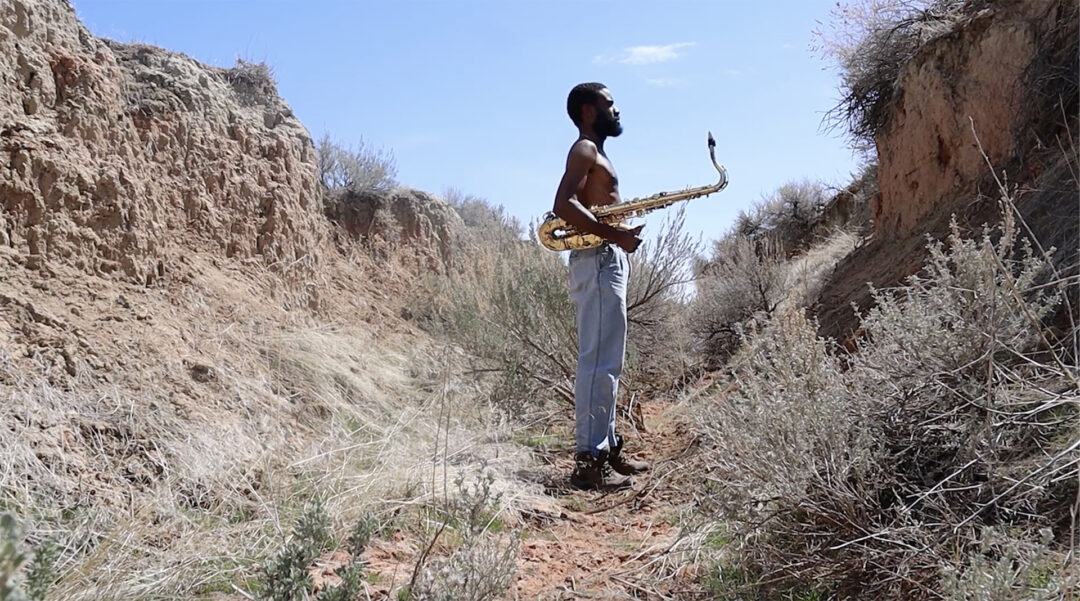
JJJJJerome Ellis, Impediment is Information, 2021, Courtesy of the Artist
JJJJJEROME ELLIS
𝄐 [Fermata]
Opening Event: Thurs 21st Jan, 6–9pm
‘If you don’t gather them all, they will never be free.’
Alexis Pauline Gumbs
Grenadian-Jamaican-American artist JJJJJerome Ellis’s (b.1989, USA) solo exhibition 𝄐 [Fermata] is the most extensive presentation of his work to date. Occupying the first floor of the CCA, the exhibition features existing and newly commissioned works that create environments for gathering and ‘holding’, within which a relationship to Black history, particularly the lives and stories of fugitive slave ancestors, can be practiced. The exhibition’s title relates to this idea of holding space, referring to a musical symbol that signals that a musician should hold a note, chord or pause. Music is central to Ellis’s multidisciplinary practice, which moves between experimental jazz, spoken word, and visual art.
At its center, the exhibition asks how it might be possible to enter into relation with our ancestors, and how art can create ceremonies and spaces for honouring, commemorating and remembering Black lives that have been erased or only partially recorded by history. Across the three spaces of the exhibition, Ellis builds environments of sound and image, through which to honour ‘runaways’: people who escaped slavery in the United States between the 1700s and late 1800s, and whose only archival record is through advertisements placed in newspapers that demanded their return. Each work loops through time, proposing escape as an ongoing condition, never achieved, and freedom as an unfinished project. Ellis’s stutter – a central presence in his music, scores, and visual practice – is an operative part of this disruption of linear time and language. Its asynchrony opens up new spaces and relationships across time and in the present.
Fugitive slave adverts placed in newspapers by owners wishing to reclaim their ‘property’ inform Ellis’s newly commissioned work, An unfinished calendar that commemorates slaves escaping their enslavers, 1673–1886 (2027). The work emerges from extensive research (begun in 2020) in which Ellis has gathered hundreds of names from databases in the United States, United Kingdom, Haiti, Jamaica, Guadeloupe, Martinique, Grenada, Barbados, St. Thomas, Trinidad, Canada, Portugal, and Brazil; including those located in Deptford, historically important docks that are local to Goldsmiths CCA. The resulting lists of names and dates of the publication are used to create a calendar; one page of paper for each day of the year, embellished with a painted flower motif. These will fill the gallery space as a delicate counter-monument, testament to the courage of those individuals and in defiance of their fragmentary record.
BIOGRAPHY
JJJJJerome Ellis was born in the USA, in 1989 and lives in Norfolk Virginia.
Read Less...