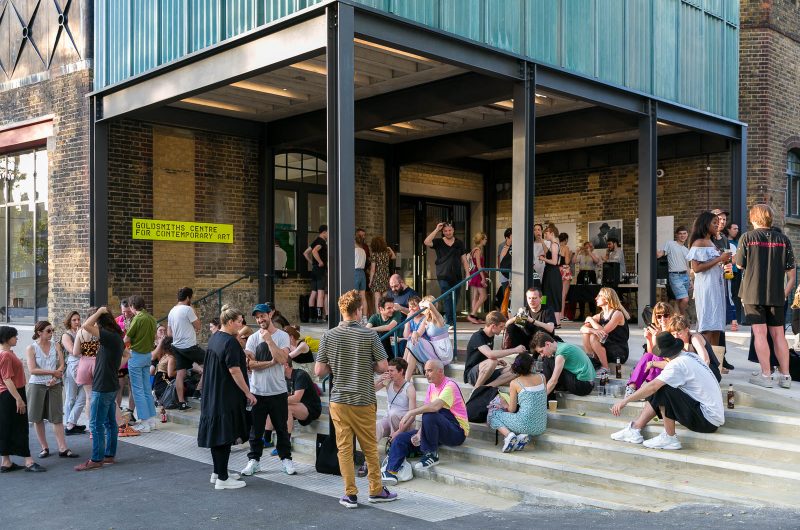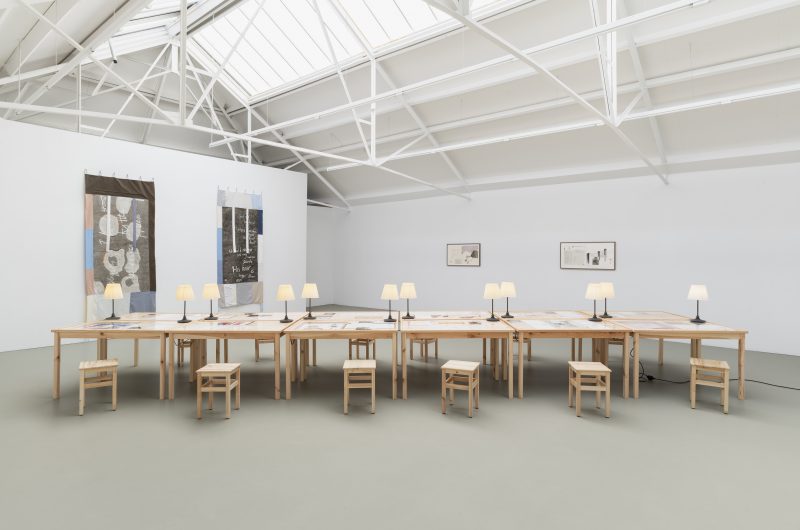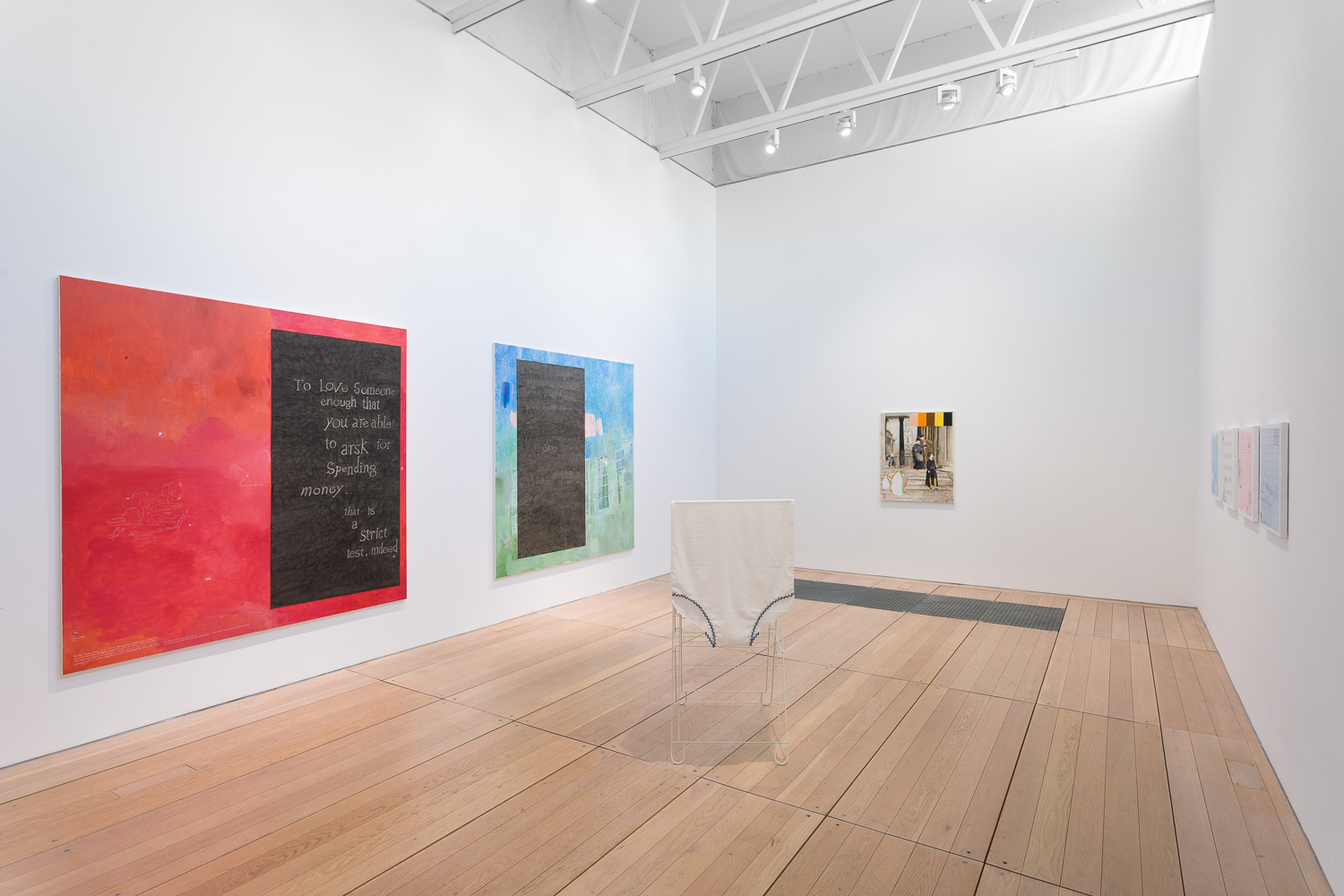
Installation view: Evelyn Taocheng Wang, Being Poetic Ruins Life, Goldsmiths CCA, London, 2026. Photo: Rob Harris.
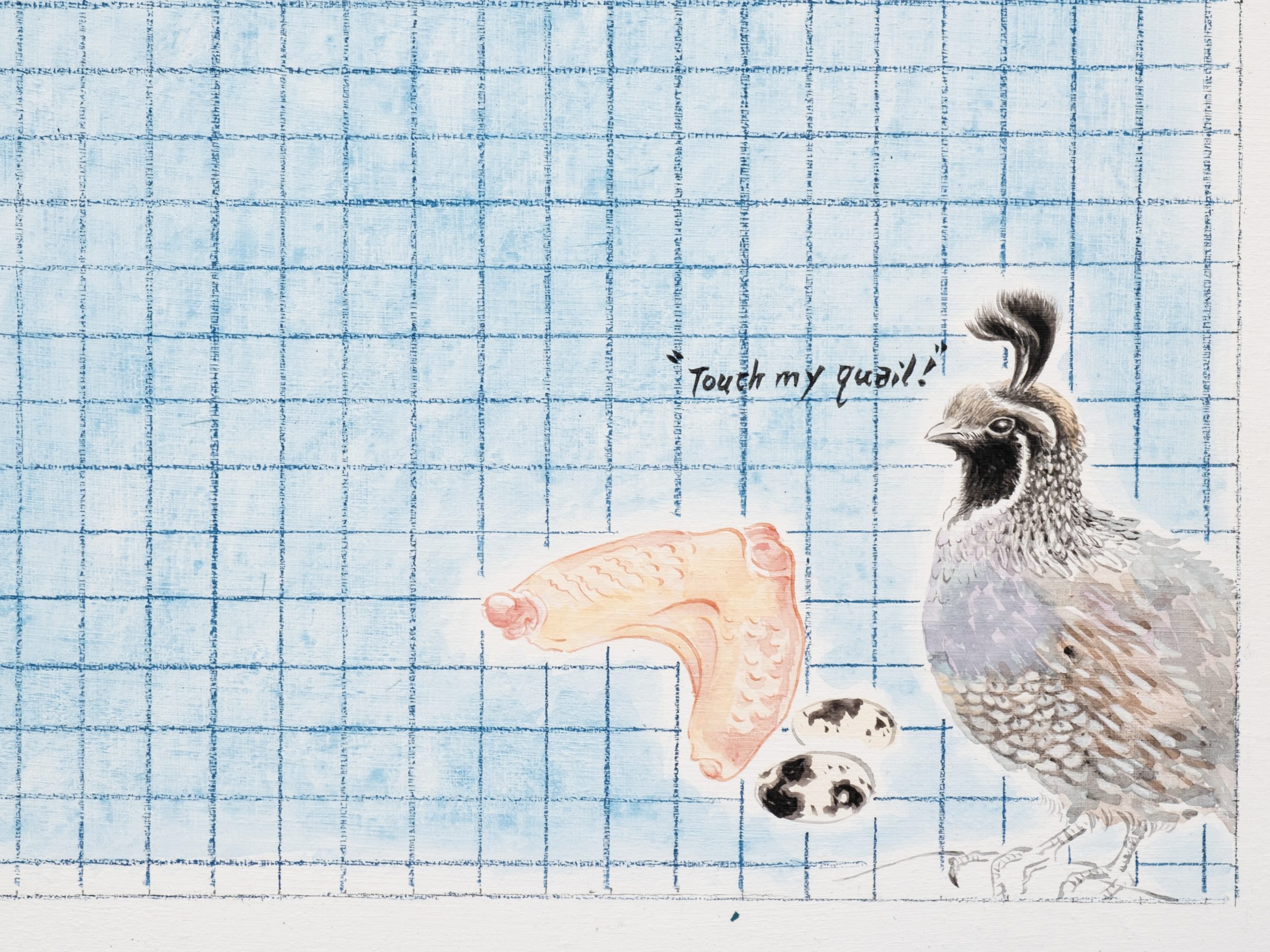
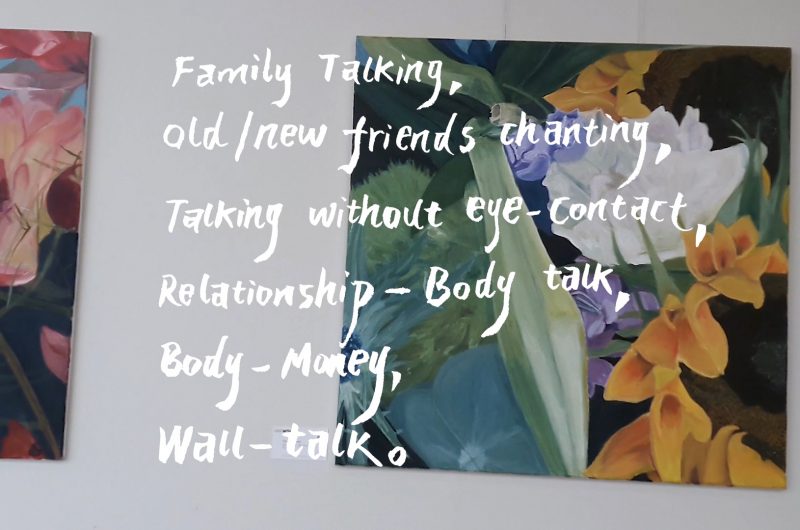
Evelyn Taocheng Wang, Mr Darcy Jumping into My Darcy's Lake, 2026 [detail]. © Evelyn Taocheng Wang 2026. Courtesy the artist; Antenna Space, Shanghai; and Carlos/Ishikawa, London. Photo: Rita Silva.
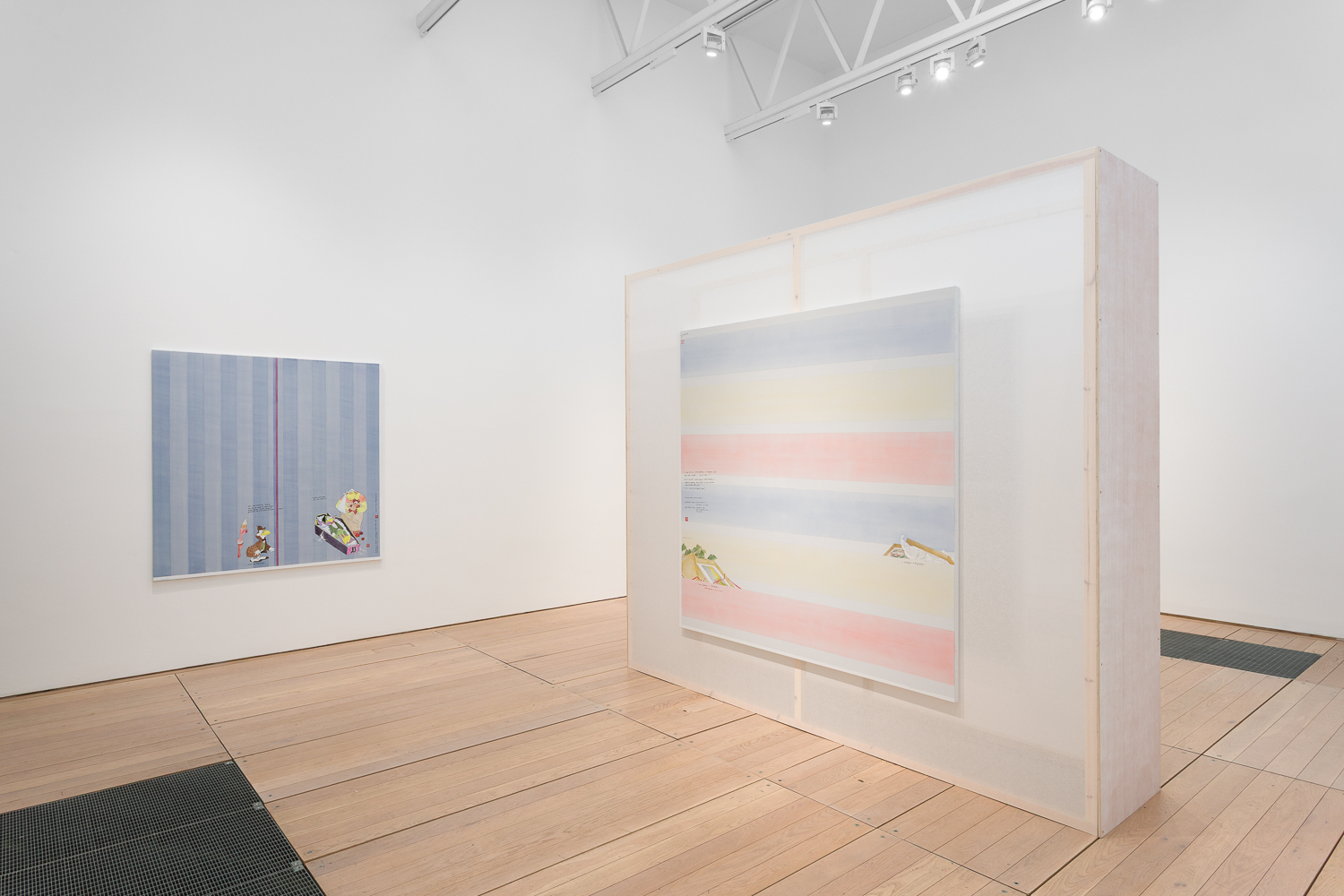
Installation view: Evelyn Taocheng Wang, Being Poetic Ruins Life, Goldsmiths CCA, London, 2026. Photo: Rob Harris.
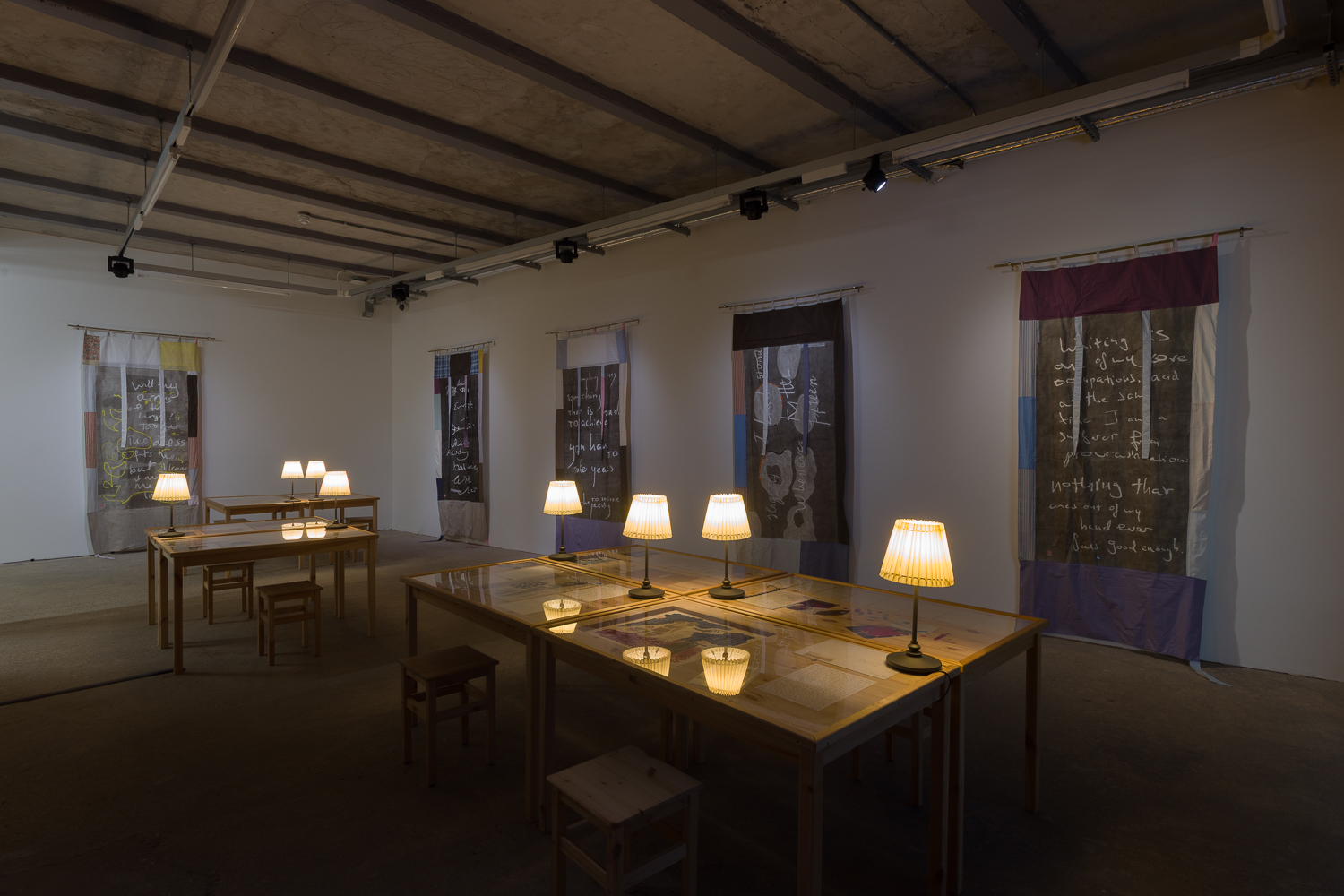
Installation view: Evelyn Taocheng Wang, Being Poetic Ruins Life, Goldsmiths CCA, London, 2026. Photo: Rob Harris.
EVELYN TAOCHENG WANG
Being Poetic Ruins Life
Audio descriptions for all artworks in the exhibition are available here on our website, and on MP3 players at the gallery reception. Click here for a transcript.
Being Poetic Ruins Life is Evelyn Taocheng Wang’s (b. Chengdu, China) first institutional exhibition in the UK. It features existing and newly commissioned works across painting, textile, installation, and video, gathered to create a ‘womb’ from within which Wang navigates Western and Chinese art history, and fantasies of British culture. The title refers to the rigorous training that Chinese poets and artists (exclusively privileged men) underwent historically, for whom it was compulsory to withdraw from life to make art. Wang asks who gets to be ‘poetic’, and whose nostalgia forms the basis for those poetics. She proposes a different artistic position; the ‘Cultural Whore’ who, steered by desire, wit, and elegance, builds her own narratives from cultural fragments.
The exhibition introduces early works, from 2008 onward, that examine fashion, language, and image as ways of navigating fluid identities, as well as works made for CCA that incorporate British cultural referents such as Virginia Woolf, Count Duckula, James Bond, Pride and Prejudice, and Merchant Ivory films, alongside two dominant figures in Wang’s work; Asian American writer Eileen Chang (1920–1995) and Abstract-Expressionist painter Agnes Martin (1912–2004).
Wang’s “eyeshadow palette of art history” assembles references, conversations, and imitations through disarming humour and high skill, in defiance of hierarchies between high and low, East and West. Collaging motifs and techniques across her works allows Wang to negotiate complex poles of identity, from gender and sexuality, to language and cultural belonging, whilst teasing essentialism and categorisation. Her navigation of Britain is replete with projections and knowing mistranslations, modelling the ways in which we assemble partial narratives and identifications in a globalised and image-saturated existence.
Painter Agnes Martin is a central figure in Wang’s later works, and this gallery brings together existing and new paintings that mimic the artist’s compositions. Wang interrupts the universalist modernity of Martin’s large-scale abstractions with overlaid forms drawn from literati painting – such as calligraphic text and seals – and gongbi-style motifs (painted with meticulous lines) that depict a cast of characters plucked from literary history and popular culture. Wang’s use of Martin can be read as a way in which to queer Western histories of modernism from the position of an outsider, or Eastern interloper, stealing back from a canon that stole from the East, and imposing her own forms that speak to the complex image exchanges that runs between cultures.
Wang graduated from a stringent art education in China, mastering calligraphy and ink painting according to the literati tradition. Literati is a refined style of Chinese painting informed by Confucianism, Taoism and Buddhism, that combines calligraphy, poetry, and ink painting. Despite the strictures of her education, Wang’s nascent practice was also fed by aspects of popular and global culture that cut against elevated literati art making, including exhibition catalogues and art history books, Western and Hong Kong New Wave DVD’s, pop music, fashion, Japanese graphic design, and translated fiction.
Moving to Europe to continue her studies in 2008, Wang had to contend with a lack of understanding of Chinese art forms amongst her peers. Her ink paintings were termed ‘drawings’ and demoted to the status of a painting study, and the Xuan paper she used was misnamed ‘rice paper’. She retaliated by calling oil paintings ‘potato’ and ‘bread’ paintings. Wang’s experience of cultural mistranslation and diasporic outsider status would come to be central to her work, providing tools through which to queer Chinese traditions which she wished to enliven, and European ones that othered her.
SUPPORTED BY
Carlos/Ishikawa, London
Antenna Space, Shanghai
The Evelyn Taocheng Wang Exhibition Circle
Joan Thewsey Legacy Gift
Mondriaan Fund

Read more…
BIOGRAPHY
Evelyn Taocheng Wang’s practice emerges from an interest in what constitutes identity and culture, and how one’s own body is culturally relative to—and intertwined with—autobiographical structures. Evoking multiple personae in her work, Wang interrogates the subject of authenticity, and how we go about performing it. Her practice spans installation, performance, video, sculpture, and a range of painting and drawing styles, while her research is based on various (art) histories, feeding from perceived concepts of East and West, offering fragmented, diary-like views of embodied personal, and external, fantasies and desires.
Born in 1981 in the Sichuan capital city of Chengdu, Wang learned about Soviet Realism, the Russian avant-garde, and European modernism in high school. At Nanjing Normal University, she studied Chinese classical literature, calligraphy, and landscape painting, as well as mathematics and English. In her work she broaches the topic of cultural difference and assimilation, drawing on her multitude of influences to play with language barriers, stereotypes, and material contradictions. An ongoing series includes imitations (or homages) to American painter Agnes Martin, which combine the abstract expressionist’s pared downlayers of mathematical precision with her own contrived motifs and styles. Her work touches on immigration and belonging, interrogating the bureaucratic insignia of authentication and the politics of assimilation.
Language is integral to her practice, allowing her to break into different characters, while using mistakes and discrepancies to negotiate identity and estrangement. Often focusing on the notion of ‘exchange’, imagined and real friendships are unravelled into their fundamental parts, dismantling binary differences between nations, histories, and individuals. Drawing herself into the body of cultural references, Wang’s method is filled with both elegance and incoherence, with an understanding that beauty must remain inexplicable.
Evelyn Taocheng Wang recently opened a solo institutional exhibition at MUSEION Museum of Modern and Contemporary Art, Bolzano. Major solo presentations of Wang’s work have been staged at institutions around the world, including the Museum Ludwig, Cologne; Rockbund Art Museum, Shanghai; the Kunstverein Düsseldorf; the Hermitage Museum, Amsterdam, as recipient of the ABN Amro Art Prize; Museum Abteiberg, Mönchengladbach, Germany; FRAC Champagne-Ardenne, Reims; SMAK, Ghent; KW Institute for Contemporary Art, Berlin, among others. Wang’s work was included in the 60th International Art Exhibition of La Biennale di Venezia curated by Adriano Pedrosa.
Wang’s work is held in several public collections, including The Museum of Modern Art (MoMA), New York; Art Institute of Chicago; Centre Pompidou, Paris; The National Museum of Art, Osaka; Museu de Arte de São Paulo (MASP), São Paulo; and the Stedelijk Museums of both Amsterdam & Schiedam.
Read Less...