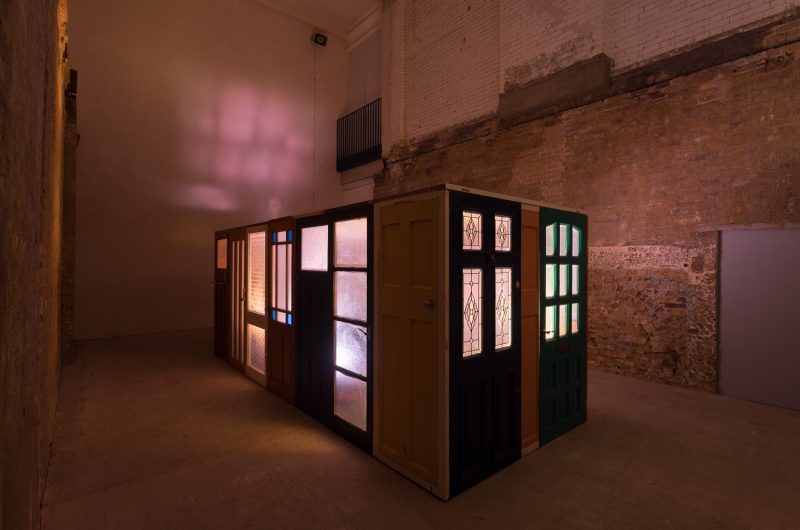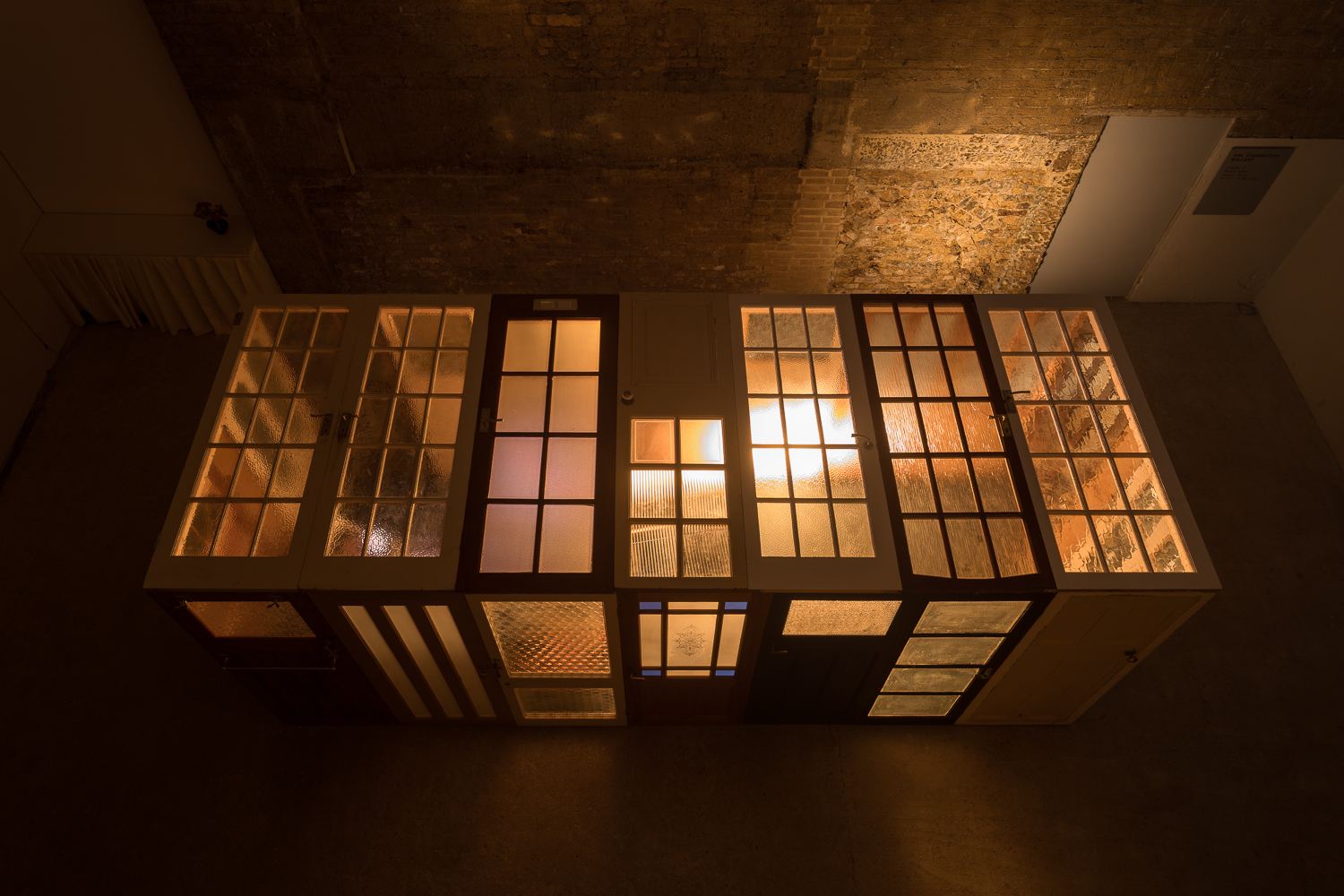
Installation view: Raheel Khan, 'Memory Police' (24 October–14 December 2025) at Goldsmiths Centre for Contemporary Art. Courtesy Goldsmiths CCA. Photo: Rob Harris.
TEXT: Matt Williams on Raheel Khan
Click here for pdf version.
Sound, Object, Threshold
Raheel Khan’s practice moves across sculpture, drawing, installation and performance, guided by an attentive engagement with construction materials, utilitarian objects and the everyday presence of sound as a means to compel acts of listening that make the infrastructures of daily life perceptible. His first public facing project, Mileage (BBC 6 Music, 2020), offers an early articulation of this approach. Developed through an open call and completed while he was working in finance, the work reflects on time, place and presence, tracing relationships between labour, movement and connectivity through sound rather than image. The composition interlaces fragments of conversation, breath and engine noise recorded with the permission of drivers and passengers from a local taxi firm in South Manchester. Khan gathered over forty hours of audio, which he later listened to closely before collaging and condensing into a fifteen-minute broadcast. The piece moves between intimacy and distance, the micro and the macro, as the mechanical rhythm of the vehicle merges with the cadence of human exchange.
Mileage operates as both portrait and social document. The taxi becomes a mobile studio, a chamber for transient narratives and unguarded reflection. Voices overlap as trails of speech dissolve into the hum of the vehicle’s mechanics. Travel unfolds as a form of collective improvisation. Passengers and drivers speak of routine, belonging and fatigue, and their words form a dispersed oral archive of post Brexit and pre COVID Britain, recorded at the outset of Boris Johnson’s venal premiership. The work situates the taxi as a provisional home, a social condenser where conversation takes place without hierarchy and listening becomes an act of recognition, reciprocity and shared experience.
Here, the habitual structures of service and movement reveal an acoustic study of community. Each repeated sound, from the click of an indicator to the closing of a door or the trace of a shallow breath, records the persistence of labour and care expressed not only through physical service but through communication and presence. These gestures expose the small exchanges that bridge solitude and solidarity. Through these fleeting moments, care emerges as a relational practice, where listening becomes both recognition and repair and sustains connection within shifting economies of labour and movement.
Born in Nottingham, educated in Manchester and now based in London, Khan draws from a geography shaped by migration, industry and reinvention. Having studied economics and worked in banking, he chose to return to higher education through a self-directed engagement with electronic music and experimental sound. This background provides the structural foundation of his practice, in which questions of value, exchange and duration are reimagined through material and acoustic form. He adapts instruments of financial measurement such as duration, flow and surplus to compose sonic works that reveal the invisible labour and systems of exchange embedded within social life. These works develop through a form of social accounting that traces how care, repetition and mutual attention sustain informal infrastructures that persist beyond official institutions. In doing so, Khan reframes the logic of value itself, echoing Justin O’Connor’s observation that “to imagine culture only through the metrics of creative industries is to accept the neoliberal fantasy that value exists solely in production and competition”.[1]
Khan positions sound as a form of social reproduction rather than production and constructs spaces of exchange in which the audible becomes a shared resource rather than a commodity. Within these environments, listening operates as both method and medium and allows material, temporal and social registers to converge. The work finds its vitality in processes of relation rather than resolution and unfolds within what Fred Moten and Stefano Harney describe as “a fugitive social life”, one that persists within and beyond institutions through improvisation, attunement and collaboration.[2]
The porous nature of sound, its capacity to leak, overlap and evade containment, acquires political force in this context. Fragments of recorded speech, low frequencies and recycled materials register not as conclusion but as continuation, offering a renewed perspective that evokes Jacques Attali’s proposition that noise “heralds new orders” and can be understood as a shared acoustic commons sustained through endurance and collective attention. Khan’s method draws from Virinder S Kalra’s account of the “micro economies of survival”, in which informal and affective practices enable communities to sustain connection amid the decline of industry and the erosion of collective institutions. Reframing Kalra’s notion of spiritual and material labour, Khan demonstrates how sound embodies shifting social, religious and economic conditions. The vibrations of his compositions, including loops, drones and residual frequencies, register the continuity of this labour, in which repetition becomes both necessity and affirmation. Kalra’s description of the Midlands as a “vernacular cosmopolitanism” resonates strongly, evoking the terrain Khan makes audible, a hybrid landscape where working class and diasporic cultures converge through overlapping rhythms of labour, migration and devotion. [3]
This spatial and acoustic continuum recalls Henri Lefebvre’s concept of rhythmanalysis, which describes the endurance of industrial time after the machinery has stopped and when rhythm becomes the measure of social life and carries the residues of work into new forms of belonging.[4] It also connects to Dhanveer Singh Brar’s formulation of “sonic ecologies”, in which vibration organises social life and generates knowledge through rhythm, density and movement.[5] Khan extends this into a curatorial and compositional method in which bass functions not as embellishment but as connective infrastructure through which individual perception converges with collective experience. His low frequency modulations produce what Brar describes as a “sonic epistemology” and transmit knowledge through vibration and affect rather than written words or visual representation. In this sense, Khan turns sound into an embodied practice of study and binds the listener within a shared sensorial field that is spatial, political and communal. This experience is collective rather than representational, a mode of relation through which presence is felt and renewed. By transforming the remnants of manufacture, migration and remembrance into resonant form, he articulates a civic language of continuity and renewal. This reorientation of value parallels Yuk Hui’s articulation of “technodiversity”, a turn towards plurality and locality in which time becomes a medium of coexistence rather than acceleration.[6] Within this expanded temporality, Khan’s installations privilege the audible and cultivate what Pauline Oliveros called “deep listening”, an embodied awareness that dissolves the distance between listener and environment.[7]
This proposition finds its most ambitious articulation to date in Memory Police (Goldsmiths CCA, 2025), which extends Khan’s inquiry into architectural and spatial form. Titled after Yōko Ogawa’s parable of state sanctioned forgetting, in which objects and memories vanish through quiet bureaucratic attrition, the exhibition translates erasure into sound and structure.[8] Rather than depict collective memory through nostalgic quotation, Khan constructs conditions of pressure through close mic acoustic recording. The material consists of intimate breaths and single exhalations through a trumpet, later abstracted through the application of sub bass frequencies that become vessels of vibration and is as physical as it is heard.
Domestic doors stand at the centre of the installation. Light filters through reeded, mottled, sandblasted and wired glass, and each pane carries traces of suburban aspiration and aesthetic obsolescence. The image of the island recalls Ogawa’s setting and the rhetoric of post Brexit isolation, placing the work within a geography of containment and populist displacement. The mass of doors forms an isolated interior, while sub bass frequencies surround and reverberate through the gallery. At first glance the sound appears to emerge from this sealed cavity, a reading Khan links to a recollection of his eldest sibling’s souped-up car fitted with a subwoofer bass box that, when activated, produced a volume incongruous with the acoustic cartography of its suburban surroundings.
Sound circulates within the enclosed geometry of the gallery, further defining the space. The walls redirect the reverberations that emerge from two utilitarian speakers and position the body as a resonant chamber that absorbs a composition of chopped, stretched and abstracted recordings. Low frequencies rise and shift as visitors move through the space and transform listening into a mode of navigation. From above, the structure appears to emit a low groan of sub bass that recalls the otoacoustic tones described by Maryanne Amacher, those moments when architecture or structure borne sound seems to perform itself inside the listener’s head.
That access to the interior is withheld places the work in conversation with Mike Kelley’s Educational Complex (1995), where incomplete architectures and blocked interiors signal the limits of what a society can remember or misremember. It also draws on the charged atmosphere of Paul McCarthy’s Bang Bang Room (1992), where the familiar comfort of wallpapered domestic walls is unsettled as mechanised doors open and close in relentless motion, making and unmaking the room through shifting surfaces and violent force. Khan’s structure, despite its physical stillness, is animated instead by moving light and a recurring vibration that affirms its presence and lends it a sense of being.
The doors that line the structure intensify this sense of embodiment. Veneered, painted or stripped, each surface bears the wear of touch, weather and routine use and holds traces of the hands and habits that shaped it. Their material presence connects suburban peripheries with the industrial legacies of the post war period and anchors the work in the lived conditions from which these objects were drawn. Sourced through Gumtree, a peer-to-peer network of domestic exchange where transactions unfold at thresholds and ownership is quietly dissolved and renewed, with each door was collected in person. Driving across South London, from Orpington to Lewisham to Ilford and Dagenham, Khan met twenty-seven individuals whose homes and stories are now embedded in the work. This labour of movement and conversation turns collection into performance and transforms first contact with each door into an embodied relation between subject and object.
A further artistic reference is Diamond Stingily’s Entryways (2021), which offers a parallel to this attention to domestic architecture since it treats the threshold of the home as a site shaped by memory, vulnerability and coded forms of belonging. Her arrangement of doors recalls the charged atmosphere of everyday passage, where access is negotiated and histories of movement and exclusion sit close to the surface. Khan’s reclaimed doors carry a similar tension and bring a lived sense of threshold into the structure.
Cut to size and reassembled, the doors form a monolith of thresholds through which light and sound inhale and exhale unevenly. This invites a connection to Keller Easterling’s account of infrastructure as a “spatial operating system”, in which residual circuits of governance persist long after their economic rationale has faded.[9] The repurposing of the doors transforms permeability into resistance and creates an impenetrable threshold. A structure that once mediated between separation and connection becomes a wall, fastening the domestic seam where intimacy meets exposure, while the shifting light that moves through the glass panels renders the familiar quietly uncanny.
Here, infrastructure becomes memorial. The exhibition becomes an archive of endurance, where discarded domestic material is recast as civic structure. In Memory Police, the work does not mourn what has vanished but moves between protection and unease, with Khan turning his attention to what persists and allowing sound to hold that persistence in place. Vibration settles into the structure as atmosphere and creates a field in which safety and anxiety sit side by side. The work listens to the fragile conditions that shape locality, community and belief and lets these drift through its surfaces in steady waves. What appeared in Mileage as an attention to relation through sound returns here with a quiet focus on how feeling shapes the presence of objects. Maintenance becomes an act of care and listening becomes a form of repair. In this closing gesture, Khan approaches culture as preservation, something sustained through repeated acts of attention. The acoustic field he constructs reveals how care endures, how labour persists and how listening becomes a shared structure through which collective life continues.
[1] Justin O’Connor, Culture Is Not an Industry (Manchester: Manchester University Press, 2024).
[2] Fred Moten and Stefano Harney, The Undercommons: Fugitive Planning and Black Study (New York: Minor Compositions, 2013).
[3] Virinder S Kalra, Sacred and Secular Musics: A Postcolonial Approach (London: Bloomsbury, 2014).
[4] Henri Lefebvre, Rhythmanalysis: Space, Time and Everyday Life, trans. Stuart Elden and Gerald Moore (London: Continuum, 2004).
[5] Dhanveer Singh Brar, Teklife, Ghettoville, Eski: The Sonic Ecologies of Black Music in the Early 21st Century (Cambridge, MA: MIT Press, 2023).
[6] Yuk Hui, The Question Concerning Technology in China: An Essay in Cosmotechnics (Falmouth: Urbanomic, 2016).
[7] Pauline Oliveros, Deep Listening: A Composer’s Sound Practice (New York: iUniverse, 2005).
[8] Yōko Ogawa, The Memory Police, trans. Stephen Snyder (London: Vintage, 2020).
[9] Keller Easterling, Extrastatecraft: The Power of Infrastructure Space (London: Verso, 2014).
Click here for pdf version.
Sound, Object, Threshold
Raheel Khan’s practice moves across sculpture, drawing, installation and performance, guided by an attentive engagement with construction materials, utilitarian objects and the everyday presence of sound as a means to compel acts of listening that make the infrastructures of daily life perceptible. His first public facing project, Mileage (BBC 6 Music, 2020), offers an early articulation of this approach. Developed through an open call and completed while he was working in finance, the work reflects on time, place and presence, tracing relationships between labour, movement and connectivity through sound rather than image. The composition interlaces fragments of conversation, breath and engine noise recorded with the permission of drivers and passengers from a local taxi firm in South Manchester. Khan gathered over forty hours of audio, which he later listened to closely before collaging and condensing into a fifteen-minute broadcast. The piece moves between intimacy and distance, the micro and the macro, as the mechanical rhythm of the vehicle merges with the cadence of human exchange.
Mileage operates as both portrait and social document. The taxi becomes a mobile studio, a chamber for transient narratives and unguarded reflection. Voices overlap as trails of speech dissolve into the hum of the vehicle’s mechanics. Travel unfolds as a form of collective improvisation. Passengers and drivers speak of routine, belonging and fatigue, and their words form a dispersed oral archive of post Brexit and pre COVID Britain, recorded at the outset of Boris Johnson’s venal premiership. The work situates the taxi as a provisional home, a social condenser where conversation takes place without hierarchy and listening becomes an act of recognition, reciprocity and shared experience.
Here, the habitual structures of service and movement reveal an acoustic study of community. Each repeated sound, from the click of an indicator to the closing of a door or the trace of a shallow breath, records the persistence of labour and care expressed not only through physical service but through communication and presence. These gestures expose the small exchanges that bridge solitude and solidarity. Through these fleeting moments, care emerges as a relational practice, where listening becomes both recognition and repair and sustains connection within shifting economies of labour and movement.
Born in Nottingham, educated in Manchester and now based in London, Khan draws from a geography shaped by migration, industry and reinvention. Having studied economics and worked in banking, he chose to return to higher education through a self-directed engagement with electronic music and experimental sound. This background provides the structural foundation of his practice, in which questions of value, exchange and duration are reimagined through material and acoustic form. He adapts instruments of financial measurement such as duration, flow and surplus to compose sonic works that reveal the invisible labour and systems of exchange embedded within social life. These works develop through a form of social accounting that traces how care, repetition and mutual attention sustain informal infrastructures that persist beyond official institutions. In doing so, Khan reframes the logic of value itself, echoing Justin O’Connor’s observation that “to imagine culture only through the metrics of creative industries is to accept the neoliberal fantasy that value exists solely in production and competition”.[1]
Khan positions sound as a form of social reproduction rather than production and constructs spaces of exchange in which the audible becomes a shared resource rather than a commodity. Within these environments, listening operates as both method and medium and allows material, temporal and social registers to converge. The work finds its vitality in processes of relation rather than resolution and unfolds within what Fred Moten and Stefano Harney describe as “a fugitive social life”, one that persists within and beyond institutions through improvisation, attunement and collaboration.[2]
The porous nature of sound, its capacity to leak, overlap and evade containment, acquires political force in this context. Fragments of recorded speech, low frequencies and recycled materials register not as conclusion but as continuation, offering a renewed perspective that evokes Jacques Attali’s proposition that noise “heralds new orders” and can be understood as a shared acoustic commons sustained through endurance and collective attention. Khan’s method draws from Virinder S Kalra’s account of the “micro economies of survival”, in which informal and affective practices enable communities to sustain connection amid the decline of industry and the erosion of collective institutions. Reframing Kalra’s notion of spiritual and material labour, Khan demonstrates how sound embodies shifting social, religious and economic conditions. The vibrations of his compositions, including loops, drones and residual frequencies, register the continuity of this labour, in which repetition becomes both necessity and affirmation. Kalra’s description of the Midlands as a “vernacular cosmopolitanism” resonates strongly, evoking the terrain Khan makes audible, a hybrid landscape where working class and diasporic cultures converge through overlapping rhythms of labour, migration and devotion. [3]
This spatial and acoustic continuum recalls Henri Lefebvre’s concept of rhythmanalysis, which describes the endurance of industrial time after the machinery has stopped and when rhythm becomes the measure of social life and carries the residues of work into new forms of belonging.[4] It also connects to Dhanveer Singh Brar’s formulation of “sonic ecologies”, in which vibration organises social life and generates knowledge through rhythm, density and movement.[5] Khan extends this into a curatorial and compositional method in which bass functions not as embellishment but as connective infrastructure through which individual perception converges with collective experience. His low frequency modulations produce what Brar describes as a “sonic epistemology” and transmit knowledge through vibration and affect rather than written words or visual representation. In this sense, Khan turns sound into an embodied practice of study and binds the listener within a shared sensorial field that is spatial, political and communal. This experience is collective rather than representational, a mode of relation through which presence is felt and renewed. By transforming the remnants of manufacture, migration and remembrance into resonant form, he articulates a civic language of continuity and renewal. This reorientation of value parallels Yuk Hui’s articulation of “technodiversity”, a turn towards plurality and locality in which time becomes a medium of coexistence rather than acceleration.[6] Within this expanded temporality, Khan’s installations privilege the audible and cultivate what Pauline Oliveros called “deep listening”, an embodied awareness that dissolves the distance between listener and environment.[7]
This proposition finds its most ambitious articulation to date in Memory Police (Goldsmiths CCA, 2025), which extends Khan’s inquiry into architectural and spatial form. Titled after Yōko Ogawa’s parable of state sanctioned forgetting, in which objects and memories vanish through quiet bureaucratic attrition, the exhibition translates erasure into sound and structure.[8] Rather than depict collective memory through nostalgic quotation, Khan constructs conditions of pressure through close mic acoustic recording. The material consists of intimate breaths and single exhalations through a trumpet, later abstracted through the application of sub bass frequencies that become vessels of vibration and is as physical as it is heard.
Domestic doors stand at the centre of the installation. Light filters through reeded, mottled, sandblasted and wired glass, and each pane carries traces of suburban aspiration and aesthetic obsolescence. The image of the island recalls Ogawa’s setting and the rhetoric of post Brexit isolation, placing the work within a geography of containment and populist displacement. The mass of doors forms an isolated interior, while sub bass frequencies surround and reverberate through the gallery. At first glance the sound appears to emerge from this sealed cavity, a reading Khan links to a recollection of his eldest sibling’s souped-up car fitted with a subwoofer bass box that, when activated, produced a volume incongruous with the acoustic cartography of its suburban surroundings.
Sound circulates within the enclosed geometry of the gallery, further defining the space. The walls redirect the reverberations that emerge from two utilitarian speakers and position the body as a resonant chamber that absorbs a composition of chopped, stretched and abstracted recordings. Low frequencies rise and shift as visitors move through the space and transform listening into a mode of navigation. From above, the structure appears to emit a low groan of sub bass that recalls the otoacoustic tones described by Maryanne Amacher, those moments when architecture or structure borne sound seems to perform itself inside the listener’s head.
That access to the interior is withheld places the work in conversation with Mike Kelley’s Educational Complex (1995), where incomplete architectures and blocked interiors signal the limits of what a society can remember or misremember. It also draws on the charged atmosphere of Paul McCarthy’s Bang Bang Room (1992), where the familiar comfort of wallpapered domestic walls is unsettled as mechanised doors open and close in relentless motion, making and unmaking the room through shifting surfaces and violent force. Khan’s structure, despite its physical stillness, is animated instead by moving light and a recurring vibration that affirms its presence and lends it a sense of being.
The doors that line the structure intensify this sense of embodiment. Veneered, painted or stripped, each surface bears the wear of touch, weather and routine use and holds traces of the hands and habits that shaped it. Their material presence connects suburban peripheries with the industrial legacies of the post war period and anchors the work in the lived conditions from which these objects were drawn. Sourced through Gumtree, a peer-to-peer network of domestic exchange where transactions unfold at thresholds and ownership is quietly dissolved and renewed, with each door was collected in person. Driving across South London, from Orpington to Lewisham to Ilford and Dagenham, Khan met twenty-seven individuals whose homes and stories are now embedded in the work. This labour of movement and conversation turns collection into performance and transforms first contact with each door into an embodied relation between subject and object.
A further artistic reference is Diamond Stingily’s Entryways (2021), which offers a parallel to this attention to domestic architecture since it treats the threshold of the home as a site shaped by memory, vulnerability and coded forms of belonging. Her arrangement of doors recalls the charged atmosphere of everyday passage, where access is negotiated and histories of movement and exclusion sit close to the surface. Khan’s reclaimed doors carry a similar tension and bring a lived sense of threshold into the structure.
Cut to size and reassembled, the doors form a monolith of thresholds through which light and sound inhale and exhale unevenly. This invites a connection to Keller Easterling’s account of infrastructure as a “spatial operating system”, in which residual circuits of governance persist long after their economic rationale has faded.[9] The repurposing of the doors transforms permeability into resistance and creates an impenetrable threshold. A structure that once mediated between separation and connection becomes a wall, fastening the domestic seam where intimacy meets exposure, while the shifting light that moves through the glass panels renders the familiar quietly uncanny.
Here, infrastructure becomes memorial. The exhibition becomes an archive of endurance, where discarded domestic material is recast as civic structure. In Memory Police, the work does not mourn what has vanished but moves between protection and unease, with Khan turning his attention to what persists and allowing sound to hold that persistence in place. Vibration settles into the structure as atmosphere and creates a field in which safety and anxiety sit side by side. The work listens to the fragile conditions that shape locality, community and belief and lets these drift through its surfaces in steady waves. What appeared in Mileage as an attention to relation through sound returns here with a quiet focus on how feeling shapes the presence of objects. Maintenance becomes an act of care and listening becomes a form of repair. In this closing gesture, Khan approaches culture as preservation, something sustained through repeated acts of attention. The acoustic field he constructs reveals how care endures, how labour persists and how listening becomes a shared structure through which collective life continues.
[1] Justin O’Connor, Culture Is Not an Industry (Manchester: Manchester University Press, 2024).
[2] Fred Moten and Stefano Harney, The Undercommons: Fugitive Planning and Black Study (New York: Minor Compositions, 2013).
[3] Virinder S Kalra, Sacred and Secular Musics: A Postcolonial Approach (London: Bloomsbury, 2014).
[4] Henri Lefebvre, Rhythmanalysis: Space, Time and Everyday Life, trans. Stuart Elden and Gerald Moore (London: Continuum, 2004).
[5] Dhanveer Singh Brar, Teklife, Ghettoville, Eski: The Sonic Ecologies of Black Music in the Early 21st Century (Cambridge, MA: MIT Press, 2023).
[6] Yuk Hui, The Question Concerning Technology in China: An Essay in Cosmotechnics (Falmouth: Urbanomic, 2016).
[7] Pauline Oliveros, Deep Listening: A Composer’s Sound Practice (New York: iUniverse, 2005).
[8] Yōko Ogawa, The Memory Police, trans. Stephen Snyder (London: Vintage, 2020).
[9] Keller Easterling, Extrastatecraft: The Power of Infrastructure Space (London: Verso, 2014).
Read Less...