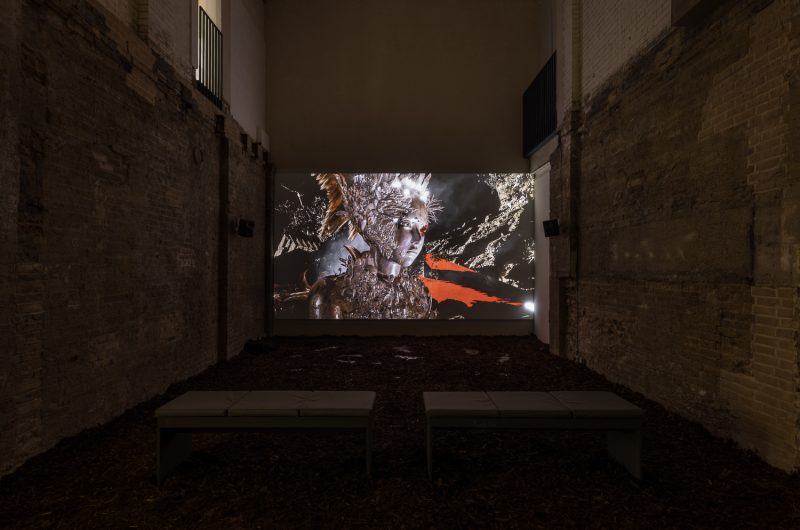
Photo: Rob Harris.
TEXT: Sophie J Williamson on Eunjo Lee
Click here for pdf version.
Sacrificial offerings, dismembered limbs and toddling concrete-formed infants populate vignettes of a world crumbling and rebuilding anew, where past laws of physics, human dominance, and life itself invert. Before the Shadow Taught the Sun depicts a post-human era in which organs and flesh pulse with uncanny life amongst the decaying ruins of steel and iron structures: the disarticulated divine body and sublime nature intertwined with the artificial and mechanical. Borrowing from Julia Kristeva’s terms, life here hovers at the threshold of the abject, at once unsettling and sacred.
Collapsing both material and immaterial worlds, Before the Shadow Taught the Sun assembles from the cacophony of mythology that emerges throughout humanity’s disparate collective past. ‘The gatekeeper’, ‘the architect’, ‘the child’, ‘the divine dead reborn’; archetypes ooze through the film, framing and unfurling the narrative. Reimaged anew, where flesh, concrete and iron fuse entities, and organic-industrial mutant bodies emerge to reanimate the rusty decay of a mechanical bygone era, these archetypal characters nevertheless offer some eerie comfort of the familiar, hidden amongst the unheimlich shadowed landscapes.
Despite cultures evolving in distinct temporal and geographic localities, the human psyche repeatedly frames experience through symbolic templates and cosmologies resurface time and again. According to Jungian psychology, these symbols are embedded in the collective unconscious—primordial blueprints of human experience: blueprints that have shaped the world around us. It could be assumed that through AI and machine learning, trained on vast corpora of human output, these same patterns will inevitably re-emerge, regenerated within new techno-cultural contexts. I asked ChatGPT: will archetypes persist? Its unnervingly colloquial reply—’The forms will change, but the archetypal energy? That stuff’s immortal’. But perhaps Lee’s world suggests something even more radical: what if AI learns not only from human culture but from more-than-human modes of knowledge? From whale song, bee dances, fungal bio-chemical signals—what kinds of architypes might be born to frame future more-than-human consciousness? As technology slips into its own evolutionary pathway, untethered from human input, it might begin reflecting not just our psyche, but universal principles of pattern, rhythm, and becoming. Lee proposes a radical reworlding: a realm where digital beings possess a spiritual potency, where the body undone is still holy, where the digital–in its reframed materiality–is equally imbued with myth. This is not transhumanist utopia, nor dystopia—it is a post-human metaphysics where organic and man-made forms merge, and digital consciousness entangles with non-dual cosmologies. The sacred here is not defined by transcendence but by entanglement.
Modernity taught us to identify as individuals, independent from the things around us. We mentally detach a sense of ‘I’ from that which enables us to survive, from our microbiome of internal inhabitants to the technologies that sustain our daily existence. And beyond this, we detach this sense of ‘I’ from the murky multitude of unknown entities, those that sit somewhere in-between the material and immaterial, the tangible and the indeterminate: dark matter, quantum entanglement, or even the fundamentals that being consciousness into being, and the sublime infinitude of other unknown unknowns. Modernity taught to see the spiritual as separate from the material, the digital as distinct from the soulful.
‘There is always warmth between the body complete and the body undone’, whispers the film’s bodiless, prophetic voice, ‘while the countless nets of gravity gently cradle the stars in the sky’.
It goes without saying that we are all celestial dust, momentarily held together in a perceived sense of ‘I’. But, as Lee’s work so astutely evokes, so too are all technologies, no matter how abstract or advanced. From tools of mass industrialisation robotics, the decaying remnants of which litter Lee’s reclaimed landscapes, to hyperconnection, crypto servers and quantum computation, all are born from the ground beneath our feet. The sleek surfaces of our smartphones and laptops, and the invisible networks that thread through the air, are made possible only through the extraction and transformation of natural materials—cobalt pulled from deep fissures, silicon smelted from sand, lithium harvested from ancient salt flats. These devices we treat as ephemeral or immaterial are, in fact, geological—composite relics of volcanic rock, fossilised sunlight, and planetary pressure. What is unmasked through Lee’s video works, and in particular Before the Shadow Taught the Sun, is that the ‘artificial’ is not apart from the natural, but a rearrangement of it: its energy sourced from the cosmos, technology is not separate from nature but its extension.
Donna Haraway’s Cyborg Manifesto—now four decades old—declared the end of the myth of binary purity. She describes the cyborg as a fusion between human and machine, organism and tool, physical and non-physical: identity and reality are always hybrid, constructed, and fluid. The cyborg was never just science fiction. It was already here: in pacemakers, insulin pumps, prosthetics–and more recently in predictive text and AI writing tools. Likewise, Lee’s co-evolved world of spiritually imbued technobodies are not a cli-fi fantasy, but a mirror to an ecological reality that is already blueprinted: where cognition and machine, flesh and filament, cease to exist in separate entities but are a fluid expression of all life. Unnerving to our contemporary human ego that supposes anthropocentric superiority, the life depicted in Before the Shadow Taught the Sun is the ultimate unfolding of the contemporary condition: the irreversible implosion into a unified technoliving system, where human greed has extracted the planet to exhaustion, and divine nature claims seeks back equilibrium. This is a world that ceases to be dictated by anthropocentric terraforming, and instead gives way to an ego-less cosmic cyborgian ecology. Life itself transcends to its primordial beginnings, a fractal process—cycling through collapse and emergence, selfhood and surrender. Identity, once defined by ego, now flickers in ever-seeping, ever-emerging constellations of universal mythology, decay and unhindered possibility.
Postscript
This text is many, many weeks overdue: I am writing from a long-sick body. Trying to force damaged neural networks back into being, words sketchily form and disappear again, ungraspable, as my body sluggishly drags itself through the long, slow fight with chronic Lyme disease. As the disease expands its reach amongst the warming forests and shifting ecologies, the inevitable comeuppance of the Anthropocene is etched into my bloodstream, nervous system, muscles, joints and brain. A body no longer fit for purpose, I connect to the world through glass screens and humming circuits. My limbs are replaced by metal carcases, energy traverse via lithium veins, and my voice carried by code: each keystroke is a quiet negotiation between broken biology and borrowed machine, offshore servers and pulsing datacentres. I emerge as signal, suspended somewhere between self and system. I am no longer just human—I am interface, network and echo. Until watching Before the Shadow Taught the Sun, I had yet to recognise this new reality as my own: a fragile organic body, propped up by code… but yet staggering toward a new kind of wholeness.
Biography
Sophie J Williamson is a curator and writer based in London and Margate. She is the initiator and convenor of Undead Matter, a commissioning, broadcasting, publishing, and research programme focused on the intimacies of dying and its dialogue with the geological. From 2013-2021, she was Exhibitions Curator at Camden Art Centre, and was previously part of the inaugural team at Raven Row (2009–13). Her writing appears in ArtMonthly, frieze, Elephant, October, and numerous exhibition publications and journals. She is currently undertaking her PhD at Goldsmiths, titled Being-with-Dying: Living with Agency in the Anthropocene.
Click here for pdf version.
Sacrificial offerings, dismembered limbs and toddling concrete-formed infants populate vignettes of a world crumbling and rebuilding anew, where past laws of physics, human dominance, and life itself invert. Before the Shadow Taught the Sun depicts a post-human era in which organs and flesh pulse with uncanny life amongst the decaying ruins of steel and iron structures: the disarticulated divine body and sublime nature intertwined with the artificial and mechanical. Borrowing from Julia Kristeva’s terms, life here hovers at the threshold of the abject, at once unsettling and sacred.
Collapsing both material and immaterial worlds, Before the Shadow Taught the Sun assembles from the cacophony of mythology that emerges throughout humanity’s disparate collective past. ‘The gatekeeper’, ‘the architect’, ‘the child’, ‘the divine dead reborn’; archetypes ooze through the film, framing and unfurling the narrative. Reimaged anew, where flesh, concrete and iron fuse entities, and organic-industrial mutant bodies emerge to reanimate the rusty decay of a mechanical bygone era, these archetypal characters nevertheless offer some eerie comfort of the familiar, hidden amongst the unheimlich shadowed landscapes.
Despite cultures evolving in distinct temporal and geographic localities, the human psyche repeatedly frames experience through symbolic templates and cosmologies resurface time and again. According to Jungian psychology, these symbols are embedded in the collective unconscious—primordial blueprints of human experience: blueprints that have shaped the world around us. It could be assumed that through AI and machine learning, trained on vast corpora of human output, these same patterns will inevitably re-emerge, regenerated within new techno-cultural contexts. I asked ChatGPT: will archetypes persist? Its unnervingly colloquial reply—’The forms will change, but the archetypal energy? That stuff’s immortal’. But perhaps Lee’s world suggests something even more radical: what if AI learns not only from human culture but from more-than-human modes of knowledge? From whale song, bee dances, fungal bio-chemical signals—what kinds of architypes might be born to frame future more-than-human consciousness? As technology slips into its own evolutionary pathway, untethered from human input, it might begin reflecting not just our psyche, but universal principles of pattern, rhythm, and becoming. Lee proposes a radical reworlding: a realm where digital beings possess a spiritual potency, where the body undone is still holy, where the digital–in its reframed materiality–is equally imbued with myth. This is not transhumanist utopia, nor dystopia—it is a post-human metaphysics where organic and man-made forms merge, and digital consciousness entangles with non-dual cosmologies. The sacred here is not defined by transcendence but by entanglement.
Modernity taught us to identify as individuals, independent from the things around us. We mentally detach a sense of ‘I’ from that which enables us to survive, from our microbiome of internal inhabitants to the technologies that sustain our daily existence. And beyond this, we detach this sense of ‘I’ from the murky multitude of unknown entities, those that sit somewhere in-between the material and immaterial, the tangible and the indeterminate: dark matter, quantum entanglement, or even the fundamentals that being consciousness into being, and the sublime infinitude of other unknown unknowns. Modernity taught to see the spiritual as separate from the material, the digital as distinct from the soulful.
‘There is always warmth between the body complete and the body undone’, whispers the film’s bodiless, prophetic voice, ‘while the countless nets of gravity gently cradle the stars in the sky’.
It goes without saying that we are all celestial dust, momentarily held together in a perceived sense of ‘I’. But, as Lee’s work so astutely evokes, so too are all technologies, no matter how abstract or advanced. From tools of mass industrialisation robotics, the decaying remnants of which litter Lee’s reclaimed landscapes, to hyperconnection, crypto servers and quantum computation, all are born from the ground beneath our feet. The sleek surfaces of our smartphones and laptops, and the invisible networks that thread through the air, are made possible only through the extraction and transformation of natural materials—cobalt pulled from deep fissures, silicon smelted from sand, lithium harvested from ancient salt flats. These devices we treat as ephemeral or immaterial are, in fact, geological—composite relics of volcanic rock, fossilised sunlight, and planetary pressure. What is unmasked through Lee’s video works, and in particular Before the Shadow Taught the Sun, is that the ‘artificial’ is not apart from the natural, but a rearrangement of it: its energy sourced from the cosmos, technology is not separate from nature but its extension.
Donna Haraway’s Cyborg Manifesto—now four decades old—declared the end of the myth of binary purity. She describes the cyborg as a fusion between human and machine, organism and tool, physical and non-physical: identity and reality are always hybrid, constructed, and fluid. The cyborg was never just science fiction. It was already here: in pacemakers, insulin pumps, prosthetics–and more recently in predictive text and AI writing tools. Likewise, Lee’s co-evolved world of spiritually imbued technobodies are not a cli-fi fantasy, but a mirror to an ecological reality that is already blueprinted: where cognition and machine, flesh and filament, cease to exist in separate entities but are a fluid expression of all life. Unnerving to our contemporary human ego that supposes anthropocentric superiority, the life depicted in Before the Shadow Taught the Sun is the ultimate unfolding of the contemporary condition: the irreversible implosion into a unified technoliving system, where human greed has extracted the planet to exhaustion, and divine nature claims seeks back equilibrium. This is a world that ceases to be dictated by anthropocentric terraforming, and instead gives way to an ego-less cosmic cyborgian ecology. Life itself transcends to its primordial beginnings, a fractal process—cycling through collapse and emergence, selfhood and surrender. Identity, once defined by ego, now flickers in ever-seeping, ever-emerging constellations of universal mythology, decay and unhindered possibility.
Postscript
This text is many, many weeks overdue: I am writing from a long-sick body. Trying to force damaged neural networks back into being, words sketchily form and disappear again, ungraspable, as my body sluggishly drags itself through the long, slow fight with chronic Lyme disease. As the disease expands its reach amongst the warming forests and shifting ecologies, the inevitable comeuppance of the Anthropocene is etched into my bloodstream, nervous system, muscles, joints and brain. A body no longer fit for purpose, I connect to the world through glass screens and humming circuits. My limbs are replaced by metal carcases, energy traverse via lithium veins, and my voice carried by code: each keystroke is a quiet negotiation between broken biology and borrowed machine, offshore servers and pulsing datacentres. I emerge as signal, suspended somewhere between self and system. I am no longer just human—I am interface, network and echo. Until watching Before the Shadow Taught the Sun, I had yet to recognise this new reality as my own: a fragile organic body, propped up by code… but yet staggering toward a new kind of wholeness.
Biography
Sophie J Williamson is a curator and writer based in London and Margate. She is the initiator and convenor of Undead Matter, a commissioning, broadcasting, publishing, and research programme focused on the intimacies of dying and its dialogue with the geological. From 2013-2021, she was Exhibitions Curator at Camden Art Centre, and was previously part of the inaugural team at Raven Row (2009–13). Her writing appears in ArtMonthly, frieze, Elephant, October, and numerous exhibition publications and journals. She is currently undertaking her PhD at Goldsmiths, titled Being-with-Dying: Living with Agency in the Anthropocene.
Read Less...